Losing my mother was the hardest thing I had ever experienced. After months of watching her health decline, I was still trying to come to terms with the fact that she was gone. But before our family had even begun to process the loss, another problem emerged: my brother’s wife had decided that she deserved Mom’s most treasured possession, a diamond ring that had been passed down through generations.
She insisted that my mother had promised it to her, even though nobody else had ever heard such a thing. What she didn’t know was that Mom had already anticipated this possibility. Before she died, she had prepared something that would make the truth impossible to ignore.
The confrontation began on the afternoon of the funeral, in the living room of the house where my mother had spent so many years.
“I think it’s time you gave me the ring.”
Chloe said it loudly enough for everyone in the room to hear.
We were surrounded by Mom’s friends, relatives, neighbors and flowers. Someone had placed a framed photograph of her on the piano. It was the picture taken at her sixtieth birthday, where she was laughing with her head thrown back. Paper plates of food nobody really wanted were scattered across every available surface. The entire house smelled of coffee and lilies.
Then my brother’s wife walked across the hardwood floor in her black heels, stopped in front of me and held out her hand.
“Excuse me?” I asked.
“Your mom promised it to me,” Chloe replied, lifting her chin. “I’m her only son’s wife. It belongs to me.”
The room fell silent.
My cousin Iris lowered her coffee cup halfway to her mouth. Aunt Marcy stared at Chloe in disbelief. Someone near the fireplace whispered, “At the funeral? Seriously?”
I looked toward my brother.
Brian was standing beside the bookshelf, staring at the floor.
“Brian?” I asked quietly.
He rubbed the back of his neck. “Harper, maybe we should talk about this later.”
Chloe gave a small, humorless laugh.
“There’s nothing to talk about. Your mom knew I’d carry the family name forward. She wanted me to have it.”
She was lying. I knew that for certain. My mother hadn’t spoken a single word during the final three weeks of her life, and before that, she had never promised Chloe the ring.
I had been there every night.
But before explaining what happened next, I need to tell you about my mother, the ring and the woman who had been asking about it long before the funeral.
My mother died on a Tuesday in early October, after a long illness that had taken almost a year to finish what it started.
I was thirty-two years old. I had a job, an apartment, a car payment and a cat named Pickle. I paid my own bills and considered myself a grown woman.
But losing Mom made me feel like a little girl again, standing in the middle of a dark room and waiting for someone to come in and turn on the light.
Nobody came.
Mom had always been the person who turned on the light.
Her name was Ruth. She had worked as a nurse for thirty-one years at the same hospital where I was born. She wore reading glasses on a beaded chain around her neck and somehow managed to lose them at least twice a day. She grew basil on her kitchen windowsill and added it to almost everything: eggs, sandwiches and, on one memorable occasion, brownies.
She hummed whenever she was nervous, laughed too loudly at her own jokes and cried at every commercial featuring a dog.
She had raised my brother Brian and me mostly by herself after Dad left when I was six. She never said anything bad about him in front of us. When I was a teenager, I once asked why.
“Because he’s still half of you,” she said with a shrug. “And I like all of you.”
That was my mother.
For months, I watched the strongest woman I knew grow weaker beneath the white blankets of her hospice bed. Her hands became thinner, her voice softer and her rings looser on her fingers. But her eyes remained the same. Even when she was in pain, she was still trying to comfort me.
When she moved into hospice, I began sleeping in the chair beside her bed.
It was a terrible green vinyl chair with a flattened cushion and a reclining lever that seemed designed to throw you backward rather than help you relax. I slept in it most nights for eleven weeks.
One night, around two in the morning, I woke with a stiff neck and found Mom looking at me.
“Go home, Harper,” she whispered, barely able to curl her fingers around mine.
“I am home,” I told her through my tears. “Wherever you are.”
She gave me a tired little smile.
“You’re so stubborn.”
“I wonder where I got that from.”
“Your father.”
“Mom.”
She laughed softly, then closed her eyes again, holding my hand until she fell asleep.
My brother Brian came to visit whenever he could.
At least, that was what he always said.
He was three years older than me. When we were children, he had been my hero. He taught me to ride a bicycle by running behind me and holding the seat. When he finally let go, he kept running anyway, shouting, “You’re doing it! You’re doing it!”
He even beat up a boy in fourth grade who called me Hairy Harper. He let me sit on his bed and listen to his CDs, although he constantly reminded me how annoying I was.
Somewhere along the way, he grew up and became quiet.
He worked in sales for a medical equipment company, traveled frequently and always seemed exhausted. When Mom became ill, he called every few days and visited on weekends when he could.
“I’ve got a lot going on at work,” he once told me in the hospice parking lot, already holding his car keys. “It’s just a really bad time.”
“It’s a bad time for everybody, Brian.”
“I know. I know.” He rubbed the back of his neck. He had done that since high school. “I’m doing what I can.”
I didn’t tell him what I was thinking. I simply nodded and went back inside.
And then there was Chloe.
Brian had been married to her for four years. She was thirty, attractive and always perfectly put together. Her nails, hair and eyebrows were immaculate. Her closet was organized by color, and her Instagram account had eleven thousand followers who regularly saw pictures of her coffee, shoes and “blessed life.”
She was always polite to Mom, but it was the kind of politeness you might show a woman working at a bank.
She also had a remarkable ability to appear whenever there was attention to be gained.
At her wedding, she cried during her own speech, then immediately looked toward the photographer to make sure he had captured the moment.
At Christmas two years earlier, Mom gave everyone handmade scarves she had knitted herself. Chloe held hers up and said, “Oh, how cute. Handmade. That’s so sweet, Ruth.”
The following spring, I spotted the scarf in a donation bag in her garage.
I never told Mom.
But I think she already knew.
The ring had been in our family for three generations.
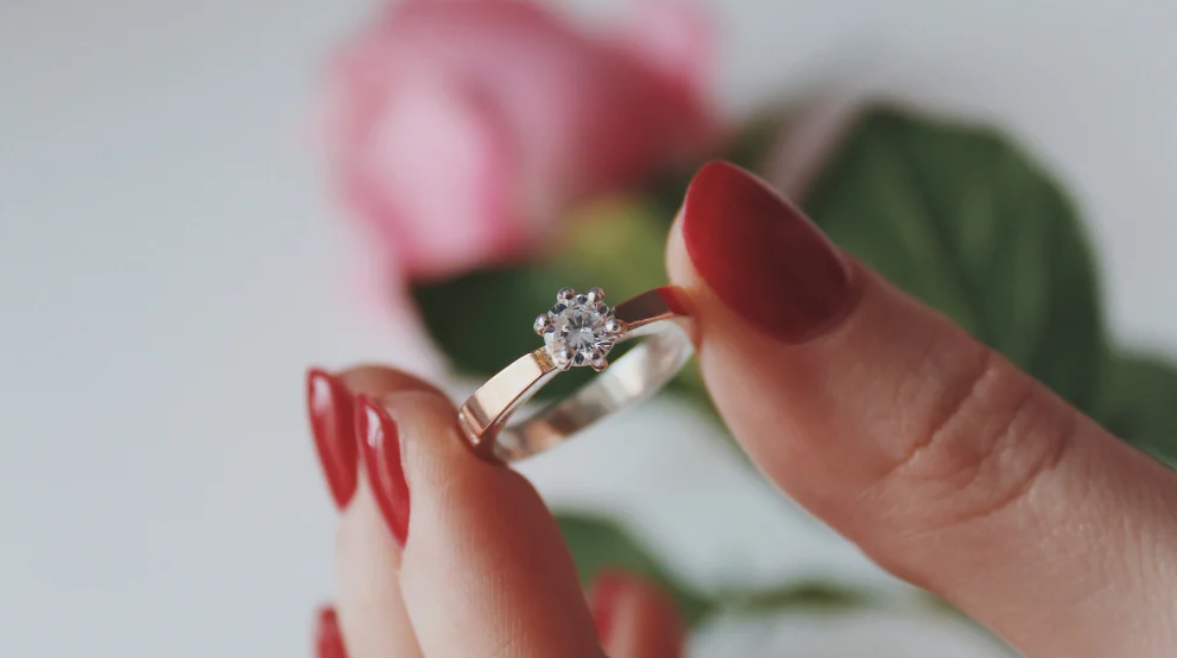
It was a vintage diamond ring with a wide gold band, worn thin underneath from decades of use. A single round diamond sat in an old-fashioned setting, catching the light like a tiny star.
My great-grandfather had bought it in 1946, after returning from the war. He had saved every dollar of his army pay to purchase it. He proposed to my great-grandmother on the front porch of her parents’ house. According to family legend, she was so surprised that she sat down on the steps and refused to get up for ten minutes.
After her, the ring passed to my grandmother and then to Mom.
Mom wore it on her right hand every day. Her wedding ring from Dad had gone into a drawer the year he left, and she never wore it again. But the diamond ring remained on her finger.
When I was little, I used to sit on the edge of her bed on Saturday mornings and slowly turn the ring around her finger while she told me stories. She talked about my great-grandmother chasing a bank robber down the street with an umbrella, my grandmother driving a milk truck during the war, and the promises people made and kept.
“This ring isn’t really about the diamond,” Mom would tell me.
“Then what is it about?”
“It’s about people who stuck around. When it was hard. When it would have been easier to leave.”
I didn’t fully understand those words until much later.
About ten years ago, a jeweler examined the ring when Mom needed its setting tightened. He whistled and estimated that it could be worth around $50,000, perhaps more, because of its age and cut.
Mom laughed right there in the store.
“Well, it’s not for sale,” she told him. “So that’s a very interesting number that doesn’t matter at all.”
To Chloe, that number mattered.
She saw the price tag.
I saw my mother.
The first time Chloe asked about the ring, Mom was still alive.
It happened on a Sunday afternoon in August. Brian and Chloe had come to visit and stayed for about forty minutes. Brian sat beside Mom’s bed and talked about the weather and football season. Chloe remained in the corner chair, looking at her phone.
When they left, I walked them out.
We stopped in the hospice hallway beside a vending machine that hummed loudly. It was filled with sad-looking snacks, including peanut butter crackers and a bag of pretzels that had been there so long I had started thinking of it as a pet.
Brian went to the bathroom, leaving Chloe alone with me.
She was looking at her reflection in the vending machine glass and fixing her hair.
“So,” she said casually. “Did she say who gets it?”
“Who gets what?”
“The ring. The diamond. Did she ever say?”
I stared at her.
“Chloe, Mom is still here.”
She pressed her lips together as if I had said something rude.
“I’m just asking. These things get complicated after someone passes. I’ve seen it happen. My friend Tiffany’s family didn’t speak for three years over a set of china. I’m trying to avoid drama.”
“By asking about her ring while she’s lying twenty feet away?”
“I said I was just asking.”
Brian returned from the bathroom, drying his hands on his pants.
“What’s going on?”
“Nothing,” Chloe said brightly. “Ready?”
I walked away because I didn’t trust myself to say anything else.
Back in Mom’s room, I closed the door and stood against it, breathing hard.
Mom was awake and looking at me.
Her door had been open. The vending machine was only twenty feet away.
She didn’t say anything. She simply held out her hand, and I took it. We sat together as the sun went down.
Two days later, Chloe asked again.
This time she called while I was eating a grilled cheese sandwich in the hospice cafeteria.
“Hey, Harper. How’s she doing?”
“About the same.”
“Oh, that’s good. That’s good.” There was a pause. “Listen, I’ve been thinking. You know how your mom was always super organized? Did she ever put anything in writing? Like, about her stuff?”
“Chloe.”
“I’m not being weird about it. I just think it’s smart to know.”
I hung up.
An hour later, she sent me a message: “Wow ok. Just trying to help.”
I didn’t respond.
She asked again two weeks later, after Mom could no longer speak in full sentences. Then she asked again after Mom had stopped speaking altogether.
She even brought it up while Brian and I were choosing flowers for the funeral.
We were standing in a florist’s shop on Main Street, trying to decide between white lilies and white roses. I kept thinking Mom would have preferred something colorful. She hated white flowers because, as she used to say, they looked like they were apologizing for something.
Chloe sat on a little bench by the window, scrolling through her phone.
“Did she ever put anything in writing?” she asked in the same bored voice. “About the ring? Because if she didn’t, legally—”
Brian looked up sharply.
“Chloe. Please.”
“What? I’m being practical. Somebody has to be.”
The florist, a gray-haired woman wearing glasses on a chain just like Mom’s, looked at Chloe for a long moment before turning toward me.
“Why don’t we go with the sunflowers,” she suggested gently. “Mixed with a little white. For balance.”
I could have hugged her.
“Yes,” I said. “Sunflowers. She’d like that.”
Here was the truth: Mom had always said the ring would stay in the family.
She had repeated it countless times at Thanksgiving, Christmas and during those Saturday mornings when I sat beside her bed turning it around her finger.
But she had never put that instruction in writing.
She didn’t have a formal will. She had a checking account, a small savings account, a paid-off house and a folder in her desk drawer labeled IMPORTANT STUFF in purple marker.
The house was supposed to be divided equally between Brian and me. That arrangement had been documented with a lawyer years earlier.
The ring, however, wasn’t mentioned anywhere.
Chloe somehow discovered that, and she treated it as an opportunity.
What she didn’t know was that Mom had heard her in the hallway beside the vending machine.
And she didn’t know what Mom had decided to do about it.
It was a Thursday in late August, a few days after that conversation.
Mom was having one of her good days. The nurses said that sometimes people near the end of life experience a brief burst of strength, almost like a candle flaring up before it goes out.
She was sitting upright in bed when I arrived after work. Her cheeks had a little color, and she had asked the nurse to brush her hair.
“Harper,” she said. “Close the door. And get my purse.”
“Your purse?”
“The brown one. In the closet.”
I brought it over. She searched through it slowly because her hands were so weak. Eventually, she pulled out a small black velvet box and a folded piece of paper.
She placed them in her lap.
“I heard her,” she said.
I didn’t need to ask who she meant.
“Mom—”
“I’m not deaf. I’m dying. It’s different.” She almost smiled. “I heard what she said in the hallway.”
I sat on the edge of the bed, unsure what to say.
“I’m not angry at her,” Mom continued. “Well, a little. Mostly I’m sad for Brian. He married a woman who asks about the diamond before the funeral. And he doesn’t see it. Or he sees it and pretends he doesn’t. I don’t know which is worse.”
“He’s scared, Mom. He doesn’t know how to deal with any of this.”
“I know.” She sighed. “He was always like that. When he was little and broke something, he’d hide under the porch until I found him. He thought if he stayed quiet enough, it would go away.”
She held out the velvet box.
“Here. Open it.”
I lifted the lid.
Inside, resting on the white satin, was a ring.
But it wasn’t the diamond.
It was a cheap pink plastic ring with a large, cloudy fake stone. The sort of thing that comes in a party favor bag, the kind little girls wear while playing dress-up.
I stared at it.
Then I laughed. The sound escaped before I could stop it.
“Mom. Is this—”
“From your dress-up box,” she said. “When you were five. You used to wear it and walk around the house in my high heels and tell everyone you were the Queen of Ohio.”
“I remember.”
“I kept it.” She gave a small shrug. “I keep everything. You’ll find out when you clean out the attic. I’m sorry in advance.”
I turned the little plastic ring between my fingers. It weighed almost nothing.
“What am I supposed to do with this?”
She handed me the folded paper.
“Read this first.”
It was a letter.
Her handwriting was shaky, much shakier than I remembered. She must have written it over several days, whenever she had enough strength. Some of the letters trailed off at the ends.
I read it once.
Then I read it again.
Finally, I covered my face with my hands and cried. Mom rubbed my back with her thin hand, just as she used to when I was little and had nightmares.
“Mom,” I said when I could speak again. “I can’t do this.”
“You won’t have to,” she replied. “Probably. Maybe she won’t ask. Maybe she’ll surprise us all and behave herself.” She raised an eyebrow. “But if she does ask—”
“If she asks, I give her the box.”
“If she asks,” Mom said, “and she’s rude about it, and she tries to take it like she’s owed something, then you give her the box. In front of whoever’s there. And you let her open it.”
“In front of people?”
“In front of people.”
Her eyes were unusually clear.
“Harper, I don’t want to embarrass anyone. I really don’t. But I’m not going to be around to stand up for you. And I know you. You’ll just give it to her to keep the peace. You’ll hand over my mother’s ring to that woman just to make the fighting stop, and you’ll feel sick about it for the rest of your life.”
I opened my mouth to argue, then closed it again.
She was right.
“This way,” she said, “I get to stand up for you one last time.”
“Where’s the real ring?”
She lifted her right hand from the blanket. The diamond was still there, loose on her thin finger, catching the light from the window.
“Right here. Until I’m done with it. Then it goes in your drawer, wrapped in something of mine. And you take it out and wear it when you’re ready.”
“What if Brian wants it?”
“Brian doesn’t care about jewelry. He never has. If he asks for it, I want you to give him something else of mine. My watch. My father’s cufflinks. He’d rather have those anyway.” She paused. “And if he asks for it because she told him to, well, the box works on him too.”
I didn’t know whether to laugh or cry, so I did a little of both.
“Mom, this is kind of mean.”
“No,” she said. “Mean would be leaving her a ring made of dog food. This is educational.”
I laughed so hard that the nurse knocked on the door to make sure everything was all right.
Two weeks later, Mom could no longer speak in full sentences.
A week after that, she stopped talking altogether.
Those were the longest three weeks of my life. I sat in the green vinyl chair, held her hand and talked about everything: Pickle knocking a plant off my windowsill, a television show she liked, and the time she got us lost on a road trip to Florida.
We had ended up in a town called Chicken, Georgia, and Mom refused to ask for directions because she said the name was a sign.
I don’t know how much she heard. The nurses said hearing is the last thing to go. I hope they were right.
Near the end, she squeezed my hand three times, very faintly.
It was something we had done when I was little. Three squeezes meant, “I love you.”
I squeezed back four times.
“I love you too.”
Before she stopped speaking, the last clear things she said weren’t about the ring.
She asked whether Brian was eating enough because he looked thin.
She asked me to water her basil plant on the kitchen windowsill because she was worried it was dying.
Then, on her last good afternoon, she made me promise something.
“Don’t let this make you hard, Harper,” she whispered. “The grief. The fighting. Any of it.”
“What do you mean?”
“Some people get hurt and they turn into stone, so nothing can hurt them again.” She squeezed my fingers. “Don’t do that. Stay soft. It’s harder. But it’s better.”
“I promise.”
She died three days later, on a Tuesday morning, with sunlight coming through the window and me holding her hand.
The diamond was still on her finger.
When the hospice nurse came in afterward, she gently slipped it off and handed it to me without a word. She had seen it every day for eleven weeks. I think she knew exactly what it meant.
That night, I took it home, wrapped it in Mom’s favorite scarf—a soft blue one with little white birds—and placed it in the top drawer of my dresser.
I didn’t wear it.
I wasn’t ready.
The funeral took place on a Saturday.
By then, I felt hollowed out, as though somebody had taken a spoon and scraped everything out of me.
I had cried so much that my face hurt. My eyes were swollen, and my hands shook so badly while I tried to put on makeup that I finally gave up and applied only a little lip balm.
Pickle sat on the edge of the bathtub, watching me.
“I can’t do this,” I told him.
He blinked slowly.
“Okay,” I said. “Fine. I’ll do it.”
The service was held at the little church on Elm Street, where Mom had sung badly in the choir for twenty years. The sunflowers looked beautiful. The florist had been right: they made the front of the church seem full of light.
Brian delivered the eulogy.
Standing at the podium in his dark suit, with shaking hands, he spoke about Mom running behind his bicycle when he was seven. He remembered her bringing chicken soup after he had his tonsils removed and sitting at the end of his bed singing old Beatles songs until he fell asleep.
His voice broke halfway through. He had to stop for a long moment.
From the front pew, I watched him. He looked so young.
For a moment, I saw my big brother again, the boy who had taught me to ride a bicycle.
Then I looked at Chloe, sitting beside me, checking her reflection in her phone screen.
After the service, everyone returned to Mom’s house.
That was what she had wanted. Years earlier, she had told me, “When I go, I don’t want some fancy hall with folding chairs. Just have everybody come to the house. Put out some food. Let people tell stories and eat my cookies.”
So we did.
The house quickly filled with relatives, friends, neighbors and former coworkers from the hospital. Everyone wore black and spoke quietly, carrying paper plates of food that nobody seemed interested in eating.
People hugged me and told me Mom had been wonderful. They said she was at peace and in a better place.
I nodded because that was what people expected.
But I couldn’t stop thinking about her bedroom, which still smelled of lavender lotion. Her slippers were beside the bed as if she might return at any moment. Her reading glasses remained on the kitchen counter, hanging from their beaded chain, exactly where she had left them.
At one point, I escaped into the kitchen.
The basil plant was still on the windowsill.
It was dying. Its leaves had turned yellow and drooped. I had forgotten to water it for two weeks. With everything happening, I simply hadn’t remembered.
I stood there staring at it, feeling something in my chest collapse.
She had asked me for one thing.
One thing.
To water the basil.
I filled a glass at the sink and poured it into the pot. The soil was so dry that the water ran straight through and spilled onto the windowsill.
“Harper?”
It was my cousin Iris, twenty-six, a kindergarten teacher with freckles and wild red hair that never stayed in a clip.
“You okay?”
“I’m fine,” I answered.
I wasn’t.
She came over, looked at the plant and then at me. Without saying anything, she grabbed a paper towel and began wiping the water from the windowsill.
“She loved this stupid plant,” I said.
“She put it in brownies once,” Iris replied.
“I know. They were horrible.”
“They were so horrible.” Iris smiled. “I ate three.”
I laughed, a small, tearful laugh. She squeezed my arm.
“Come back out when you’re ready. I’ll save you a lemon bar before Uncle Rob eats them all.”
Chloe wore a fitted black dress that looked expensive, probably custom-made. Her hair had been professionally styled in perfectly arranged loose waves.
She moved through the house as though she were hosting a party.
Standing near the front door, she greeted people as they arrived, accepting condolences with one hand resting on Brian’s arm and the other near her chest.
She was also wearing a bracelet I had never seen before. It was gold, with small diamonds all the way around it. It caught the light whenever she moved her hand.
Aunt Marcy noticed it too. She was Mom’s younger sister, sixty-one years old, five feet tall and incapable of keeping an opinion to herself.
“That’s new,” she whispered, nodding toward Chloe’s wrist.
“I think so,” I replied.
“Hmm,” Aunt Marcy said.
That was all, but I understood exactly what she meant.
A little later, she stood beside me near the window and squeezed my shoulder.
“Your mother would be proud of how strong you’re being,” she murmured.
I almost laughed.
Strong? I felt like glass, as though the slightest touch would shatter me.
“I don’t feel strong,” I admitted.
“That’s usually how you can tell,” she replied.
Then Chloe cleared her throat.
Loudly.
The sound cut through the quiet conversations. People turned. Someone put down a fork.
Chloe stood in the middle of the living room, beside the piano and the photograph of Mom laughing at her sixtieth birthday.
She looked directly at me, then walked across the room, her chin raised and her heels clicking against the hardwood floor.
Click. Click. Click.
She stopped in front of me.
“I think it’s time you gave me the ring,” she said.
Her voice was sharp enough to silence the entire room.
I stared at her.
“Excuse me?”
“Your mom promised it to me,” she repeated confidently, as though everyone already knew. “I’m her only son’s wife. It belongs to me.”
For a moment, I couldn’t breathe.
People froze in the middle of conversations. Iris lowered her coffee cup. Aunt Marcy’s mouth fell open. Mr. Delgado, Mom’s neighbor of thirty years, slowly pulled his hand away from a lemon bar.
Someone near the fireplace whispered, “At the funeral? Seriously?”
Even Brian wouldn’t look at me.
“Brian?” I asked quietly.
He rubbed the back of his neck and stared at the floor.
“Harper, maybe we should talk about this later.”
Later.
I wanted to scream. I wanted to tell him Chloe was lying and that he knew it. Mom hadn’t spoken a single word in three weeks. She couldn’t possibly have promised anyone anything.
Chloe gave another humorless laugh.
“There’s nothing to talk about,” she said. “Your mom knew I’d carry the family name forward. She wanted me to have it.”
My hands curled into fists.
I wanted to tell her she had no right to stand in my mother’s house, beside her flowers and photograph, surrounded by grieving friends, and lie about a promise my mother could no longer deny.
But I had spent eleven weeks sitting in a green vinyl chair beside a hospice bed.
And I had learned something about silence.
Sometimes silence isn’t weakness.
Sometimes silence is simply waiting.
Chloe held out her hand, palm up, and smirked.
“Don’t make this ugly, Harper.”
My fingers found the velvet box in my cardigan pocket.
I had carried it every day since Mom died. To the funeral home, to the florist and to the church that morning. I had told myself it was silly, that Chloe would never actually ask. Not today. Not here.
Mom knew better.
I pulled out the black velvet box and placed it in Chloe’s open hand.
She snatched it immediately.
Her fingers closed around it as though she had just won a prize. Her eyes lit up with something I can only describe as pure greed.
For a moment, nobody moved.
Then Chloe lifted her chin and looked around the room, almost daring anyone to challenge her.
“Thank you,” she said. There was no gratitude in her voice. “At least someone here understands what your mother wanted.”
My stomach tightened, but I remained still.
Brian finally looked up. His face had gone pale. He was staring at the box in his wife’s hand, and something in his expression suggested he had suddenly realized what was about to happen.
“Chloe,” he said. “Maybe don’t open it here.”
She frowned.
“Why wouldn’t I?”
“Because this isn’t the time,” he muttered.
She laughed under her breath.
“You heard your sister. She gave it to me.”
Aunt Marcy stepped forward, her eyes wet and furious.
“Chloe, have some respect.”
“I do have respect,” Chloe snapped. “That’s why I’m honoring her promise.”
Her promise.
Those two words nearly broke me.
Mom had used her last strength to squeeze my hand, not to discuss jewelry. She had worried about whether Brian was eating enough. She had asked me to water her basil plant. She had made me promise not to let bitterness turn me hard.
That was what mattered to her.
Not diamonds.
I swallowed the ache in my throat and watched as Chloe opened the lid.
The silence in the room changed.
Inside the box was no vintage diamond ring.
There was a folded note resting on the white satin.
Underneath it sat a cheap pink plastic ring with a large, cloudy fake stone. The kind that comes in a party favor bag. The kind a five-year-old wears while stomping around in her mother’s high heels and telling everyone she is the Queen of Ohio.
Chloe’s mouth fell open.
Her cheeks turned a deep, blotchy red, starting at her neck and creeping toward her perfectly styled hairline.
“What is this?”
A few people gasped. Someone near the dining table tried to cover a laugh with a cough. It was a terrible cough, and nobody was fooled.
I stepped closer. My voice was steady, although my hands were trembling.
“Read the note.”
Chloe glared at me.
“Did you do this? Is this some kind of sick joke?”
“Read it,” Brian said.
His voice sounded rough and different. Everyone turned toward him.
That made Chloe pause.
She grabbed the note and unfolded it with angry, jerky movements. Her eyes moved across the page.
Then the color drained from her face.
“What does it say?” Aunt Marcy asked quietly.
Chloe pressed her lips together and said nothing.
She didn’t have to. I knew every word.
Mom had written the letter in August, while she could still hold a pen. She had worked on it over several days, during the hours when she had enough strength. Her handwriting was shaky, and some letters trailed off at the ends, but it was unmistakably hers.
When Chloe remained silent, Brian crossed the room and gently took the note from her.
He looked at me for a long moment.
Then he began reading aloud.
“To the person who opens this box looking for my ring instead of remembering my life,” he read quietly, his voice carrying through the silent room. “I hope this small surprise teaches you what I could not say kindly enough. The real treasure in this family was never a diamond. It was love, loyalty, and showing up when it mattered.”
The room was so quiet I could hear Chloe breathing.
Mr. Delgado bowed his head. Iris covered her mouth with both hands.
Brian continued, but his voice began to crack.
“My ring is staying with Harper. She held my hand through the hardest nights. But more than that, she loved me without ever asking what she would get in return.”
He stopped. His jaw tightened, and he swallowed hard.
Then he continued.
“Brian,” he read, his voice breaking completely on his own name. “My dear boy. I hope you find the courage to know the difference between peace and silence.”
His hand dropped to his side. The paper hung from his fingers.
Chloe stood frozen in the middle of the living room, holding a pink plastic ring in her perfectly manicured palm.
I could barely see through my tears.
I had promised myself I wouldn’t cry in front of Chloe. Not at the funeral. Not that day.
But this was no longer about her.
This was my mother reaching across the impossible distance between us, still defending me, still teaching us and making sure the truth had a place to stand even when she couldn’t stand there herself.
This way, I get to stand up for you one last time.
Brian looked at his wife, then at me.
“Harper,” he whispered. “I’m sorry.”
The words were small.
But they were the first honest thing he had said all day.
Chloe’s embarrassment quickly turned into anger.
“So you set me up?” she demanded, turning toward me.
“No,” I replied. “Mom did.”
“That’s insane. She was dying. She wasn’t even in her right mind—”
“She wrote that in August,” I interrupted. “She was sitting up in bed. She had just had her hair brushed. She asked for her purse. And she heard you, Chloe. In the hallway, beside the vending machine, when you asked whether she had said who would get the ring. Her door was open.”
Chloe’s mouth opened, then closed.
“She heard every word,” I added.
Chloe looked around, searching for someone who might support her.
She found nobody.
The relatives who had been too polite to speak earlier were now staring at her with open disgust. Aunt Marcy crossed her arms. Iris slowly shook her head. Uncle Rob, who rarely said anything, muttered, “Unbelievable,” loudly enough for everyone to hear.
Even Brian looked at his wife as though he had suddenly woken up in a room he no longer recognized.
“Brian,” Chloe said. “Say something.”
He stared at her for a long moment.
“I didn’t know,” he said, his voice shaking. He was speaking to me, not her. “I didn’t know she wrote that. I swear I didn’t.”
“You knew Mom had never promised Chloe anything.”
He flinched as though I had slapped him.
“You knew,” I repeated more quietly. “You were there, Brian. Some of the time. You knew she stopped talking. You knew she never said that.”
“I should have said something.”
“Yes,” I answered softly. “You should have.”
Chloe made a strangled, furious sound and shoved the velvet box into Brian’s chest so hard that he stumbled backward.
The plastic ring fell out, bounced across the hardwood floor and rolled underneath the piano.
Chloe turned and stormed toward the hallway. Her heels struck the floor with far less confidence than they had on the way in.
Click. Click. Click.
A moment later, the front door slammed so hard that one of the framed photographs on the wall tilted sideways.
Nobody chased her.
Not even Brian.
He simply stood in the middle of the living room, holding the note in both hands as though it weighed more than any diamond ever could.
Aunt Marcy came to me first.
She didn’t say anything. She simply wrapped both arms around my shoulders. She was so short that her head barely reached my chin, and I folded into her embrace.
For the first time that entire day, I let myself sob.
Not the quiet, careful crying I had been doing all morning. The real kind, the kind that shakes your whole body and makes sounds you didn’t know you could make.
Aunt Marcy held on and rocked me gently.
“She got her,” she whispered fiercely into my shoulder. “Oh, Ruthie. You got her good.”
I laughed in the middle of my sobbing. It came out as a hiccup.
Behind me, Mr. Delgado bent down with a grunt and reached beneath the piano. He came back holding the pink plastic ring between two fingers.
He walked over and placed it in my hand.
“I think this belongs to the Queen of Ohio,” he said gently.
I stared at him.
“Your mother told that story at every block party for twenty-five years,” he explained. “You and those high heels.”
That made me cry even harder, but this time it was a different kind of crying.
The guests left slowly.
Some hugged me at the door. Others simply squeezed my hand. A few of Mom’s former nursing colleagues stopped to share stories I had never heard.
They told me how she had once talked a man out of leaving the emergency room against medical advice by threatening to sit on him. They remembered how she brought homemade basil pesto to every staff potluck for thirty years. Everyone secretly hated it, but nobody ever told her.
“We’re going to miss that pesto,” one of them said, wiping her eyes.
“No, you’re not,” I replied.
She laughed.
“No. We’re not. But we’ll miss her.”
By seven o’clock, the house was quiet.
Iris washed the dishes. Aunt Marcy wrapped the leftovers in foil and labeled every package with a marker, just as Mom used to do. Uncle Rob took out the trash, then fell asleep in Mom’s recliner and had to be woken up before he could go home.
Eventually, only Brian and I remained.
I sat on the living room couch beneath the lamp. Mom’s photograph on the piano still seemed to be smiling at nobody.
Brian came and sat beside me, leaving a space between us.
He was still holding the note. The paper had become soft and wrinkled from being held so tightly.
For a long time, neither of us spoke.
Then he asked, “Do you hate me?”
I looked at him.
He seemed younger somehow, as though his suit no longer fit and every excuse he had been carrying for the past year had finally fallen away.
“No,” I said. “But I’m hurt.”
He nodded, his eyes shining.
“She’s texted me eleven times,” he said, holding up his phone. “Chloe.”
“What is she saying?”
“That you humiliated her. That I should have defended her. That your whole family has always hated her.” He placed the phone face down on the coffee table. “She says Mom was manipulated. She says you wrote the note yourself.”
“That’s Mom’s handwriting.”
“I know it’s Mom’s handwriting, Harper.” He almost laughed. “I’ve been getting birthday cards in that handwriting for thirty-five years. I know what her e’s look like.”
He looked down at the letter.
“She knew, didn’t she? About me. About all of it.”
“She knew you were scared.”
“She knew I was a coward.”
“She didn’t say that.”
“She didn’t have to.” He pressed his thumb against the paper, right where Mom had written his name. “The difference between peace and silence. She meant me. She meant that I’ve been keeping quiet and calling it keeping the peace.”
He remained silent for a long time.
“Chloe’s been asking about that ring since the day we got engaged,” he finally admitted.
I stared at him.
“What?”
“She asked me whether Mom would ever give it to her for the wedding. Something old, you know? I told her no. It was a family thing and would probably go to you someday. She went quiet, then kept bringing it up. Every Christmas, every visit. Your mom’s ring is so pretty. Do you think she’d let me borrow it for the gala? That ring would look so good with my engagement ring.”
He shook his head.
“I kept changing the subject. I thought she’d eventually drop it.”
“She didn’t.”
“No.” He rubbed his face with both hands. “And when Mom got sick, it got worse. Chloe would look up what old diamonds sold for. I once saw a jeweler’s website open on her laptop. I didn’t say anything.”
“Brian.”
“The bracelet,” he said quietly. “The one she wore today. She bought it last month on our credit card. Four thousand dollars.” He gave a hollow laugh. “She said it was an early anniversary present to herself. She deserved something nice after a hard year.”
I didn’t respond.
“We have a lot of debt, Harper. More than you know. More than I ever told Mom. And I think somewhere in her head, Chloe believed that ring would fix it.”
He turned toward me.
“I forgot how to be your brother,” he whispered. “Somewhere along the way, I forgot.”
I looked at him for a long moment.
I thought about the bicycle, about him running behind me and shouting, “You’re doing it! You’re doing it!” even after he had let go of the seat.
“Then remember,” I told him.
He took a long, shaky breath.
“I’ll try.”
It wasn’t a promise, not yet.
But it was honest.
And that was a start.
I went home around nine.
My apartment was dark and quiet. Pickle was waiting on the back of the couch. He meowed as if I had kept him waiting far too long and, more importantly, forgotten his dinner.
I fed him, took off my black dress and put on an old T-shirt of Mom’s that I had taken from her closet the week before. It still smelled faintly of her lavender lotion.
Then I went into my bedroom and opened the top drawer of my dresser.
The blue scarf with the little white birds was exactly where I had left it.
I slowly unwrapped it.
The ring was inside.
The wide gold band, worn thin underneath. The single round diamond in its old-fashioned setting. It caught the light from my bedside lamp and cast a tiny star onto the ceiling.
I hadn’t touched it since the night Mom died. I had been afraid to.
I picked it up and slid it onto my right hand, the same hand on which Mom had worn it.
It fit, a little loosely, just as it had on her finger near the end.
It felt heavier than I expected.
Not because of the diamond, but because of everything it represented: my great-grandfather saving his army pay, my great-grandmother sitting on the porch steps in shock, my grandmother and her milk truck, and Mom laughing in the jewelry store because the ring’s value didn’t matter.
It was about people who stuck around when things were hard, when leaving would have been easier.
I sat on the edge of my bed and slowly turned it around my finger, just as I used to do with Mom’s ring on Saturday mornings.
Then I took the pink plastic ring from my cardigan pocket and put it on my other hand.
I sat there wearing both.
The Queen of Ohio.
And for the first time since Mom died, I no longer felt like I was standing in a dark room waiting for someone to turn on the light.
Four days later, Brian called.
“Can I come over?” he asked. “To Mom’s house. Tomorrow. I want to help clean out her things.”
“You don’t have to.”
“I know I don’t have to,” he replied. “That’s kind of the point.”
He arrived at nine the following morning with two cups of coffee and a box of doughnuts. He wore jeans and an old college sweatshirt and looked as though he hadn’t slept.
“Where’s Chloe?” I asked.
“At her sister’s,” he said, placing the coffee on Mom’s kitchen counter. “We’re taking a break. For a little while.”
“Oh, Brian.”
“It’s okay.” He raised a hand. “It’s not okay, but it’s the right thing for now. We need to figure some things out. The money. Everything.”
He paused.
“I told her I’m not going to pretend anymore. I’m not going to keep quiet just to keep things calm. She didn’t like that.”
“I’m sorry.”
“Don’t be. Mom was right.” He almost smiled. “She was right about everything, wasn’t she? It’s really annoying.”
We spent the entire day in Mom’s house.
We went through her closet, her dresser and the bathroom cabinet containing thirty-seven half-empty bottles of lavender lotion. We opened the hall closet and found every school project we had made since kindergarten, including a papier-mâché volcano Brian had built that still had baking soda crusted inside.
“She kept this?” he asked in horror, holding it up. “This is from 1998.”
“She kept everything,” I reminded him. “She warned me. She said she was sorry in advance.”
In Mom’s desk drawer, inside the folder marked IMPORTANT STUFF in purple marker, we found an envelope with Brian’s name on it.
He opened it slowly.
Inside were my grandfather’s gold cufflinks and Mom’s old wristwatch. It was the watch she had worn through thirty-one years of nursing shifts, its face cracked from years of use.
A sticky note was attached, written in Mom’s shaky handwriting.
“For my boy. You always liked these better anyway. Wear them to something happy.”
Brian sat down right on the floor of Mom’s bedroom.
He held the watch in both hands and cried in a way I hadn’t seen since we were children.
I sat beside him. I didn’t say anything. I simply leaned my shoulder against his.
After a while, he leaned back.
The basil plant survived.
I hadn’t expected it to. When I took it home to my apartment after the funeral, it was brown, brittle and almost completely dead.
I watered it every day anyway, placed it on my sunny windowsill and even talked to it, which I realize sounds a little crazy.
Three weeks later, one tiny green leaf pushed through the soil.
Then another.
By Thanksgiving, the plant was bushy, green and larger than it had ever been at Mom’s house.
I brought it to Aunt Marcy’s for Thanksgiving dinner and placed it in the middle of the table as a centerpiece.
“Is that Ruthie’s basil?” Aunt Marcy asked.
“It is.”
“I thought it was dead.”
“So did I.”
“Please,” Iris said, “don’t put any of it in the stuffing.”
Everyone laughed.
Brian laughed the loudest.
He came alone that Thanksgiving and sat beside me. On his wrist was Mom’s old watch, the one with the cracked face. It didn’t keep very good time anymore, but he didn’t care.
A few weeks before Christmas, Chloe sent me something in the mail.
It arrived in a small padded envelope with no return address. I recognized her handwriting immediately, the large, loopy letters on the label.
I almost threw it away without opening it.
Then I remembered Mom’s words.
Stay soft. It’s harder. But it’s better.
So I opened it.
Inside was the black velvet box.
Brian must have given it back to her, or perhaps she had taken it with her when she left. I never asked.
I lifted the lid.
The note was gone. Brian had kept it, and it now sat in a frame on his nightstand.
But the satin wasn’t empty.
There was a small slip of paper with a single line written in Chloe’s familiar handwriting:
“I’m sorry about what I said at the funeral. —C.”
That was all.
No explanation. No excuses. No mention of the ring, the bracelet, the eleven text messages, the debt or the vending machine.
I read it three times.
I still didn’t know exactly how I felt. It wasn’t enough. Not nearly enough. But I didn’t think Chloe knew how to say more than that, and I suspected it had cost her something even to write those few words.
I placed the note back inside the box and put it in my drawer, beside the blue scarf with the little white birds.
I didn’t write back.
Not yet.
Maybe someday.
In January, Brian told me Chloe had started seeing a counselor. They were both attending sessions, together and separately. He said it was difficult and that some weeks were better than others.
He also told me she had returned the bracelet.
“Are you going to stay together?” I asked.
He was quiet for a long time.
“I don’t know,” he finally said honestly. “But whatever happens, I’m not going to hide under the porch anymore.”
I stared at him.
“Mom told me about that,” he said with a small smile. “In her letter from the will. She wrote, ‘You used to hide under the porch when you broke something. You don’t have to anymore. Just come out and say what happened.’”
“She told me that too,” I replied. “About the porch.”
“Of course she did.” He shook his head. “She was always one step ahead of us.”
Almost a year has passed now.
I wear the ring every day, on my right hand, just as Mom did. I’ve already caught it against a car door once, and now it has a small scratch beside the setting, joining all the other little marks left by the women who wore it before me.
Sometimes, when I’m nervous, I turn it slowly around my finger.
The pink plastic ring lives on my bathroom windowsill, beside the basil plant. I moved the plant there because it gets the best light. Every morning when I brush my teeth, I see them both.
People occasionally ask me about the plastic ring. Friends who visit, my new neighbor and even a man I went on a date with in the spring. He picked it up and looked at me as though I might be a little strange.
I tell them the story.
Not the whole thing. Usually, I leave out the funeral. I simply tell them about a little girl stomping around in her mother’s high heels, wearing a plastic diamond and announcing to everyone that she was the Queen of Ohio.
And about a mother who kept that little ring for twenty-seven years.
Because she kept everything.
Because to her, the plastic ring and the diamond ring meant the same thing.
I used to believe the real treasure was the diamond: the one my great-grandfather had saved his army pay to buy, the one worth fifty thousand dollars, the one Chloe wanted so badly that she was willing to stand in the middle of a funeral and lie for it.
But Mom understood something I hadn’t.
During the last good afternoon she had, she didn’t spend her strength writing instructions about who would receive her money, furniture or house.
She wrote a letter to make sure the people she loved would be all right without her.
She wanted to make sure I wouldn’t give away something important just to keep the peace.
And she wanted Brian to finally come out from under the porch.
The diamond is beautiful, and I’m grateful to wear it.
But the real thing she left me wasn’t inside a velvet box.
It was a phone call every Sunday. A hand holding mine in a hospice bed, squeezing three times. A basil plant that almost died but didn’t. A brother who showed up at nine in the morning with doughnuts and stayed long enough to cry on the floor of our mother’s bedroom.
Love, loyalty and showing up when it mattered.
That was what she was really trying to leave behind.
And somehow, even after she was gone, she made sure we received it.