At sixty-seven, after undergoing surgery on both knees, I had learned that even an ordinary journey could become exhausting when I couldn’t stretch my legs properly.
I had been looking forward to traveling to Cape Town to meet my newborn grandson, and I wanted to make sure the long flight wouldn’t leave me in unbearable pain. That was why I had spent an additional thousand dollars on a more comfortable seat. What I never expected was that two strangers would turn that simple decision into a confrontation I would remember long after the plane landed.
I’m sixty-seven years old, and after having both knees operated on, spending fifteen hours sitting on a plane is extremely uncomfortable.
So when I booked my flight to Cape Town to visit my daughter and finally meet my newborn grandson, I decided to pay extra for a premium economy seat. The upgrade cost me another $1,000, but I knew I would need the additional space.
I never imagined that, before the plane had even taken off, I would have to defend my right to sit in the seat I had paid for.
The trouble started while passengers were still settling into their seats.
“Excuse me, ma’am. Would you mind switching seats with my wife?”
The young man sitting beside me in the window seat raised his left hand and wiggled his fingers. A shiny new wedding band caught my attention.
“We just got married!” he announced. “It’s our honeymoon!”
I smiled. I’m sixty-seven, and I still love a wedding.
“Congratulations!” I said warmly. “That’s wonderful. Where is your wife sitting?”
He turned around and pointed toward the back of the aircraft, beyond the curtain and the small galley where the coffee machines were kept.
“Economy,” he replied.
I looked down at my legs. Both knees had long, pale scars running down the front, hidden beneath my trousers. I had undergone two operations to replace them, four years apart.
“I’m sorry, honey,” I told him. “But I really need the extra room.”
His smile disappeared immediately.
“Seriously?” he said. “You’re going to make newlyweds spend their honeymoon flight apart?”
I had no idea, sitting in seat 22C with my small travel pillow and a bottle of water, that refusing his request would turn the next several hours into such an unpleasant experience.
And I certainly didn’t know that, before we crossed the Atlantic, his new wife would discover something about him that he had never intended her to find out.
My name is Margaret Ellison. I’m sixty-seven years old, and for most of my life, saying no has been one of the hardest things for me to do.
My late husband, Robert, used to tease me about it.
“Maggie,” he would say, “you’d apologize to somebody for stepping on your foot.”
He wasn’t wrong.
Once, I paid for a stranger’s groceries because she was eleven dollars short and looked at me while standing in line. On another occasion, I allowed my neighbor’s teenage son to practice driving in my car because his mother asked me and I couldn’t find a polite way to refuse. He ended up backing into my mailbox, and somehow I was the one who apologized.
I had spent most of my life trying to make everyone around me comfortable, even when doing so made things harder for me.
Perhaps especially when it did.
Robert was different.
He was a gentle, soft-spoken man who taught high school history for thirty-four years. He wore cardigans, read the newspaper from beginning to end every morning, and cried at the end of every movie featuring a dog.
But he never confused being kind with allowing people to take advantage of him.
During both of my knee surgeries, Robert was always the one who spoke up when I couldn’t.
When a nurse repeatedly forgot my pain medication, I lay in my hospital bed suffering because I didn’t want to bother her. Robert went straight to the nurses’ station and waited patiently until someone came.
When my physical therapist pushed me too hard and I started crying from the pain, I apologized. Robert simply said, “Excuse me. She’s done for today.”
And when I felt too embarrassed to request a wheelchair at the airport the year after my second surgery, he went to the counter and asked for one himself.
“She isn’t being dramatic,” he told the woman at the desk. “She’s being sensible. There’s a difference.”
Robert died three years ago after suffering a stroke on a Tuesday morning in October. He had been in the garden, raking leaves.
We had been married for forty-one years.
Since his death, I have had to learn to manage everything on my own. I’ve had to call plumbers, argue with the cable company, and tell car salesmen that I didn’t need extended warranties. I’ve also had to explain that I didn’t need to call my son before making a decision, especially since I don’t have a son.
Some days, I manage quite well.
Other days, I still struggle.
The trip to Cape Town was supposed to be something wonderful.
My daughter, Claire, had given birth to her first child in August. A little boy named Noah.
Claire had moved to Cape Town five years earlier for work. She was an architect, and at a conference she had met Pieter, a tall, quiet South African engineer with red hair and the gentlest hands I had ever seen.
They married on a beach two years after meeting. Robert walked her down the aisle through the sand, wearing his best suit and no shoes.
It was the last wedding he ever attended.
When Noah was born, Claire began sending me photographs every single day. There were pictures of him sleeping, yawning, wearing a tiny knitted hat made by Pieter’s mother, and even frowning at the camera as though he already had strong opinions about the world.
I printed every photograph on my little home printer and covered the refrigerator with them. Eventually, there was so little empty space left that I could barely see the refrigerator itself.
Every morning, while my coffee was brewing, I looked at those pictures and imagined the moment I would finally hold him.
Claire had offered to come visit me instead.
“We could fly to you, Mom,” she suggested over the phone. “Maybe in a few months, when he’s a little bigger.”
But traveling for fifteen hours with a newborn sounded miserable for everyone. Besides, I wanted to see her home, the life she had built, the kitchen she had designed herself, and the garden with the lemon tree she had told me so much about.
I wanted to see the place where my grandson would grow up.
There was only one problem: the flight.
It was a nonstop journey from Newark to Cape Town, lasting fifteen hours.
I could walk reasonably well these days. Most mornings, I walked two miles around the reservoir behind my house, and on Tuesdays I attended water aerobics.
But keeping my knees bent for too long was another matter. They became stiff, swollen, and painful. Sometimes, after sitting for several hours, I could barely stand.
Fifteen hours with my knees pressed against the seat in front of me would have been unbearable.
So I started looking at the upgrade options.
Premium economy offered more legroom, a seat that reclined farther, and a small footrest. The additional cost was $1,040 each way.
I sat at my kitchen table and stared at the price for a long time.
Robert and I had always been careful with money. We were both teachers, clipped coupons, and kept our cars until they were no longer worth repairing. In forty-one years of marriage, we had taken only one proper vacation: Niagara Falls, for our twenty-fifth anniversary.
Spending more than a thousand dollars on a seat seemed extravagant.
It felt like something other people did.
I nearly closed the page on my computer.
Then I heard Robert’s voice in my head, as clearly as if he were sitting beside me.
“She isn’t being dramatic, Maggie. She’s being sensible. There’s a difference.”
So I clicked the button.
I chose aisle seat 22C, with extra space in front of it. That way, I could stretch my legs into the aisle when the food cart wasn’t coming through, and I could get up and walk without climbing over another passenger.
After booking it, I closed my laptop and spent about an hour feeling guilty.
Eventually, I made myself stop.
I had worked hard for that money. I had spent thirty-one years teaching third grade. I was allowed to use some of my savings for something I genuinely needed.
On the morning of the flight, my neighbor Dolores drove me to Newark Airport.
“You’re going to love it,” she said throughout the drive. “You’re going to hold that baby, and you’re going to cry like a waterfall.”
“I know,” I replied.
“Take a million pictures.”
“I will.”
Then, as she pulled up to the curb, she turned toward me.
“And Margaret, ask for a wheelchair at the gate. Don’t be stubborn.”
“I don’t need a wheelchair.”
“You need one to get to the gate. It’s a mile through that terminal. I’ve seen what you’re like after going grocery shopping.”
I didn’t answer.
She looked at me.
“Robert would make you,” she said.
So I requested the wheelchair.
A young man named Marcus helped me through security and pushed me all the way down the long terminal to my gate. He chatted the entire way about his girlfriend, who was studying nursing, and his mother, who apparently made the best jollof rice in New Jersey.
When we arrived, I tried to give him a twenty-dollar tip.
He refused.
“My grandmother had both her knees done,” he explained. “She’d kill me.”
When premium economy passengers were called to board, I was among the first to enter the aircraft.
I found seat 22C, settled into it, and stretched my legs forward.
For the first time in a long while, my knees weren’t touching the seat in front of me.
I almost cried right there.
I placed my little travel pillow behind my lower back and put my water bottle in the seat pocket. I also placed my knee medication in its small orange bottle where I could reach it easily.
Then I took out my mystery novel, a story about a lighthouse, removed my shoes, and put on the compression socks Claire had reminded me to wear.
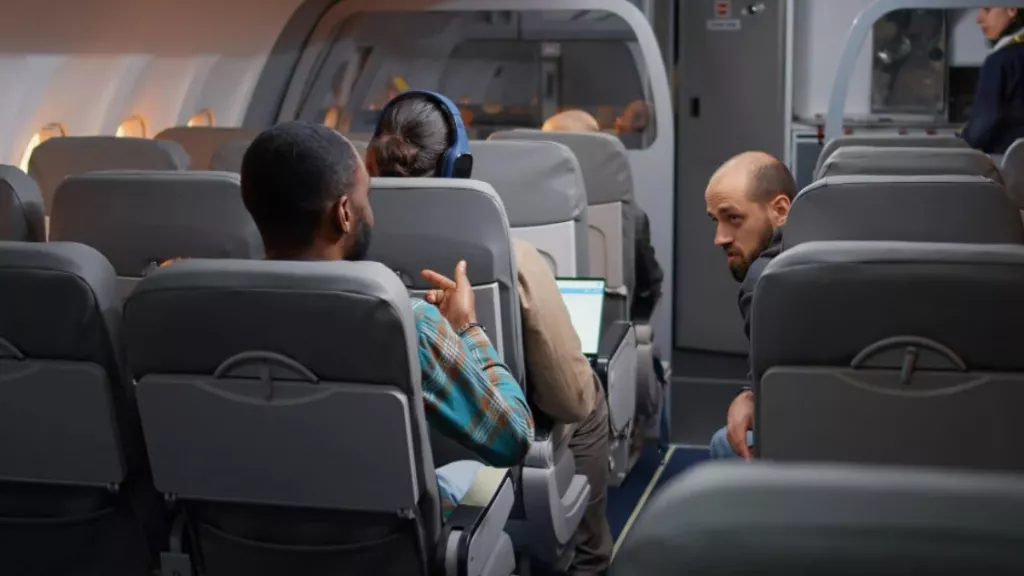
I was just beginning to relax when the young man beside me turned around.
He had been sitting in the window seat, looking at his phone with his earbuds in. Now he removed them.
He looked about thirty, with neatly styled hair, very white teeth, and an expensive navy-blue quarter-zip sweater with a small logo on the chest.
And, of course, that bright new wedding ring.
“Hi,” he said. “I’m Ethan.”
“Margaret,” I replied.
“My wife and I just got married,” he announced. “Last Saturday.”
“Congratulations,” I said, genuinely happy for him. “That’s wonderful.”
“Thanks. Actually, I wanted to ask you a favor.”
He explained that his wife, Lily, was sitting farther back in economy class.
“Would you switch with her?” he asked. “So we can sit together?”
I hesitated.
Looking at his hopeful expression, I will admit that my first instinct was to agree.
That had always been my instinct: say yes, make the other person happy, be accommodating, and avoid creating a problem.
I could almost feel the word forming in my mouth.
Then I thought about my knees.
They were already a little stiff after the drive, the wheelchair ride, and standing in line at the gate.
And I thought about the fifteen hours ahead of me.
Fifteen hours in an economy seat, with my knees cramped and no room to stretch properly.
I would arrive in Cape Town barely able to walk. I might spend the first two days on Claire’s couch with ice packs on both knees, unable to stand and rock my grandson.
“I’m sorry,” I said. “But I paid extra for this seat. I’ve had both knees replaced, and I need the room.”
He glanced down at my legs.
“You’re sitting down either way,” he replied.
I blinked.
“Yes,” I said. “But I need the extra space to stretch them. It’s a long flight.”
He leaned back.
“Come on. It’s our honeymoon.”
I tried to offer a reasonable alternative.
“Perhaps you could ask the airline about upgrading her. There might be an empty seat up here.”
He gave a short, sharp laugh.
“A thousand dollars? You’re kidding, right?”
“Then perhaps someone in economy could switch with you, so you could sit back there with her.”
His expression hardened.
He looked at me for a long moment.
“Have a heart, lady,” he said before turning back toward the window.
I put my earbuds in.
My hands were shaking a little. I couldn’t understand why. I hadn’t done anything wrong. Still, my face felt hot, and my stomach tightened in that familiar way it always did when I thought someone was angry with me.
I started an audiobook, closed my eyes, and hoped the conversation was over.
It wasn’t.
Shortly after takeoff, Ethan began coughing.
At first, I thought nothing of it. Airplanes are dry, and people cough.
But then I noticed that every time he coughed, he turned his head toward me.
Not toward the window. Not into his elbow.
Straight at my face.
They were loud, wet coughs with his mouth wide open.
I waited until the fourth one before speaking.
“Excuse me,” I said. “Would you mind covering your mouth?”
He looked at me, shrugged, and coughed again. This time a little more quietly, but still into the space between us.
About twenty minutes later, he started watching a movie on his phone.
Without headphones.
It was an action film filled with explosions, car chases, and a man shouting about a bomb. The volume was turned all the way up. I could hear every word despite my earbuds and the audiobook playing through them.
The woman across the aisle turned around and looked in our direction.
“Could you please turn that down?” I asked. “Or use your headphones?”
He let out a long, exaggerated sigh.
“Can’t a guy enjoy his honeymoon?” he said.
He lowered the volume slightly. Perhaps by one notch.
I considered calling the flight attendant. My finger even moved toward the small button on my armrest, the one marked with the picture of a person.
Then I pulled it away.
I didn’t want to make a scene. I didn’t want to become that older woman complaining about a young passenger watching a movie. I didn’t want everyone around us turning to stare, and I certainly didn’t want Ethan telling people I was difficult.
I told myself he would stop.
I told myself to be patient.
Then he opened a bag of crackers.
They were the small orange cheese crackers in a crinkly plastic package.
But instead of simply taking them out and eating them, he kept shaking the bag hard every time he reached inside, as though he were trying to get the last crumbs from the bottom.
The bag was still full.
Crumbs flew everywhere: across the armrest, onto my sleeve, my lap, and even the cover of my book. A little orange cloud of cracker dust seemed to settle over everything.
“Oops,” he said.
He didn’t look particularly sorry.
I brushed the crumbs off slowly, one piece at a time.
“Please,” I said. “Be careful.”
He leaned toward me, so close that I could smell the cheese crackers on his breath.
“Still comfortable, Grandma?” he whispered.
My face went hot, all the way to my ears.
I wanted to tell him exactly what I thought of his behavior. I had taught third grade for thirty-one years, and I had met eight-year-olds with better manners.
The words were right there.
Instead, I stared at the seat in front of me, at the little screen and the safety card in the pocket.
I said nothing.
Robert would have spoken up immediately. He would have done it calmly, politely, and firmly.
“Excuse me, son. That’s enough.”
I wished he were there so badly that my throat tightened.
About two hours into the flight, a young woman appeared beside our row.
She was blonde and pretty, wearing a pink sweatshirt with the word BRIDE printed across the front in sparkling white letters. Her hair was tied up in a large, messy bun, and she wore a diamond ring about the size of a chickpea.
“Ethan!”
He looked up from his phone and grinned.
“Babe!”
She glanced down at me, then at my seat, my stretched-out legs, and my little pillow.
“Oh,” she said, her voice changing. “You’re the lady who wouldn’t switch.”
I removed my earbuds.
“Yes,” I replied. “I’m sorry, but I need this seat.”
She looked at Ethan.
He looked back at her.
They exchanged a small glance and a smile.
Then, without asking permission or saying another word, she climbed over me.
She placed one knee on my armrest, put her other foot on my footrest, and climbed right over my legs before dropping herself onto Ethan’s lap in the window seat.
Her elbow pressed painfully into my ribs as she passed. Her long hair brushed against my face, smelling of coconut, and her foot landed on my left knee, right on top of the surgical scar.
Ethan wrapped his arms around her waist.
“Much better,” he announced loudly enough for the surrounding passengers to hear.
Lily giggled.
“Guess we’re a little cramped!” she said.
Then she twisted around on his lap and leaned across him to kiss him. Her body tipped toward me, and her arm knocked against my tray table. My cup of water slid toward the edge, and I managed to catch it just before it fell.
I pulled as far back as I could, toward the aisle.
In doing so, my right knee struck the metal bar beneath the seat in front of me.
A sharp pain shot through my entire leg.
It travelled from my hip all the way down to my ankle. It was hot, intense, and immediate.
I gasped.
“Please,” I said, my voice trembling. “You’re hurting me.”
Lily barely looked at me.
“Sorry!” she replied cheerfully. “Newlyweds, you know?”
Then she went back to kissing him.
Ethan pulled away just long enough to look at me with a smirk.
“You know,” he said, “you could solve this whole problem.”
I sat there with my knee throbbing in time with my heartbeat. Lily’s shoulder was pressed against my arm, her hair was in my face, and her glittery sweatshirt was only a few inches from my nose.
People around us were watching. The man across the aisle, the woman in front who had turned around in her seat, and even a teenage boy two rows ahead who was holding his phone.
I could feel my face burning.
I thought about the thousand dollars I had spent. I thought about the thirteen hours still ahead of us.
And I thought about arriving in Cape Town, walking into the arrivals hall, seeing Claire, and finally holding Noah for the first time.
I had imagined that moment so many times while looking at his photographs on my refrigerator.
I wanted to be able to stand when I held him.
For another minute, I sat there trying to decide what to do.
Part of me wanted to give up and say, “Fine. Take it. Take the seat.” I wanted the situation to stop. I wanted the other passengers to stop looking at me. I wanted everyone to feel comfortable again.
That was exactly what I would have done three years earlier, thirty years earlier, or at almost any other point in my life.
I opened my mouth.
Then I remembered something.
It had happened about fifteen years earlier, when our neighbor, Gerald Pike, came to our house one Saturday afternoon to complain about our fence.
He claimed it was six inches over the property line, blocked the sunlight from his tomato plants, looked terrible, had a squeaky gate, and allowed him to hear our dog.
He stood on our porch and complained for an hour and ten minutes.
I made him iced tea.
I apologized four times.
I offered to repaint the fence, oil the gate, and even move the dog.
He kept complaining.
Robert listened to the entire thing from the porch swing, with his newspaper resting on his lap. He didn’t interrupt once.
When Gerald finally ran out of things to say, Robert folded his newspaper.
“Gerald,” he said calmly, “what would you like us to do?”
Gerald blinked.
“What?”
“You’ve explained everything you don’t like,” Robert replied. “I understand all of it. Now tell me what reasonable solution you’d accept, and we’ll talk about it.”
Gerald opened his mouth, closed it, and then opened it again.
He had no answer.
He had never wanted a solution. He simply wanted to complain and make someone else feel bad.
Eventually, he went home and never mentioned the fence again.
That night, I asked Robert how he had known what to say.
He was brushing his teeth. He took the toothbrush out of his mouth and looked at me.
“Maggie, never argue with someone who’s determined to make you miserable.”
He rinsed his mouth.
“Just give them a fair way out. Then let them show everybody who they are.”
Sitting in seat 22C, with my knee aching and a stranger’s elbow pressed against my ribs, I remembered those words.
Give them a fair way out.
Let them show everyone who they are.
And suddenly, I knew exactly what to do.
I took a deep breath, removed my other earbud, folded both of them, and placed them in my lap.
Then I smiled.
“All right, you two,” I said. “You’ve won.”
Lily’s face immediately brightened. She stopped kissing Ethan and turned toward me.
“Really?”
“Absolutely,” I replied.
Then I reached up and pressed the little button on my armrest.
Ding.
Ethan gave me a huge, triumphant grin. A flight attendant was already walking down the aisle. She was a woman in her fifties, with dark hair pulled into a neat bun and a navy-blue uniform decorated with a small gold wing pin.
Her name tag read NADIA.
“Yes, ma’am?” she asked.
Ethan didn’t even let me answer.
“She finally agreed to switch!” he announced.
“Oh,” I said. “Not quite.”
His grin faltered.
I turned toward Nadia.
“Ma’am, please listen carefully.”
She looked at me, then at the woman sitting on the young man’s lap, and finally back at me. She waited.
“My seatmate and his wife would very much like to sit together,” I explained. “And I think that’s lovely. They have just married, and I’m happy for them.”
I folded my hands in my lap.
“As long as I can remain in the seat I purchased.”
Nadia looked between us.
“Of course, ma’am,” she replied.
I gestured politely toward Ethan.
“So, could you please help this young man find a seat in economy, next to his wife?”
There was a brief silence.
Then Lily smiled as though I had just solved a difficult puzzle.
“Oh! That would work!”
Ethan’s grin disappeared completely.
“What?”
“If there’s an empty seat near your wife,” I continued calmly, “you could move back there. Then the two of you could sit together for the entire flight.”
I smiled at him.
“For your honeymoon.”
Lily twisted around on his lap to look at him.
“That’s actually a really good idea, babe.”
Ethan stared at her.
“I’m not moving to economy,” he said.
Lily frowned.
“Why not?”
“Because I paid for this seat.”
I folded my hands a little tighter.
“So did I,” I replied.
Nadia remained perfectly composed. She had clearly been doing this job for a long time. Twenty years, perhaps. She had probably seen just about everything.
“Sir,” she said to Ethan, and then addressed Lily, “ma’am, I’m going to need you to return to your assigned seat. Passengers cannot share a seat during the flight. It’s a safety issue. If we encounter turbulence, someone could be seriously injured.”
Lily slowly climbed off Ethan’s lap and stood in the aisle.
But she didn’t leave.
Instead, she looked down at her husband.
“Why can’t you just come sit with me?” she asked. “There’s an empty seat right next to me, Ethan. The passenger who was in the middle seat was moved to another row. There’s a whole empty seat.”
Ethan avoided her eyes.
He looked toward the window, then at his phone, and finally at the back of the seat in front of him.
“Because I don’t want to spend fifteen hours back there,” he replied.
I watched Lily’s expression change.
It was subtle, just a slight shift around her eyes.
“Wait a minute,” she said slowly. “You told me the airline messed up our seats.”
Ethan glanced at Nadia and then at me.
“Can we talk about this later?”
“No,” Lily replied. “You told me you had booked us together and that the airline had separated us. You said it was their fault.”
“I booked the flights,” Ethan answered.
“That’s not what I asked.”
Nadia stepped in gently.
“Ma’am, I’d be happy to discuss your seating options with you. But I need you to return to your seat first. We can talk in the galley.”
Lily nodded, but she still didn’t move.
She was staring at Ethan.
“Did you book us together or not?”
Ethan rubbed his forehead.
“Not exactly,” he finally admitted.
“What does ‘not exactly’ mean?”
He remained silent for a long moment. By now, the passengers around us had stopped pretending they weren’t listening. The woman in front had turned completely around, the man across the aisle had removed his earbuds, and the teenage boy two rows ahead had put down his phone.
Finally, Ethan spoke.
“I booked premium economy for me,” he said quietly. “And economy for you.”
Lily stared at him.
“Why?”
“Because two premium seats were really expensive, babe. With the hotel and everything.”
“But you said…” Her voice began to rise. “You told me we would both have extra room. You showed me a picture of the seats and said, ‘Look at all that legroom, babe. We’re going to sleep the whole way.’”
Ethan didn’t answer.
“Ethan.”
“I figured someone would switch,” he finally said.
The entire section fell silent.
Lily looked at him for a long time.
“You figured some random stranger would give me a thousand-dollar seat for free?”
Ethan lowered his voice.
“Babe, can you please stop making this a big deal?”
She took a step away from him, moving into the aisle.
“You lied to me,” she said.
He didn’t respond.
Then Lily turned toward me and looked at me properly for the first time.
“Did he tell you the airline had separated us?” she asked.
I shook my head.
“No, honey. He asked me to give you my seat, and I explained that I had problems with my knees. I’ve had both of them replaced, and I can’t sit for fifteen hours without enough room to stretch.”
Lily frowned.
“He told me you were being rude about it,” she said. “He said you were really nasty. He told me you laughed at him.”
“I said I was sorry,” I replied quietly. “I explained that I had paid extra because sitting for that long is painful for me. That’s all.”
Lily turned back toward Ethan.
“You told me she got upgraded for free,” she said. “You said she was some rich woman who had received a free upgrade and was being selfish about it.”
Ethan stared out the window.
Lily’s cheeks turned bright red, and the colour spread down her neck.
She looked at my knees, at my legs stretched out beneath the seat in front of me, and at my compression socks.
“I thought she was refusing just to be difficult,” she said quietly.
She swallowed.
“And then I came up here, climbed over her, and sat on your lap. Right on top of her.”
“You were only joking around,” Ethan muttered, looking toward the window.
“No,” Lily said clearly. “We weren’t joking around. We were being awful.”
She turned toward me.
“I’m sorry,” she said. “I’m really, really sorry.”
I looked at her flushed face, her sparkling BRIDE sweatshirt, and the large diamond ring on her finger.
I believed she meant it.
But my knee was still throbbing. My ribs still hurt where her elbow had pressed against them, and I could still feel her hair brushing my face.
“Thank you,” I said. “I appreciate the apology.”
Lily nodded, turned around, and followed Nadia down the aisle, through the curtain, and toward economy.
She didn’t look back at Ethan.
He remained seated beside me, arms crossed, jaw tight, and breathing heavily through his nose.
“Are you happy now?” he muttered.
I looked at him.
“I’d be happy if you stopped bothering me.”
He gave a short, unpleasant laugh.
“You’ve ruined our honeymoon,” he said.
Something inside me finally gave way.
It wasn’t exactly anger. I was simply exhausted.
Tired of being blamed for things I hadn’t done. Tired of apologizing. Tired of making myself smaller just to keep other people comfortable.
Sixty-seven years of it.
“I didn’t book your tickets,” I said.
His jaw tightened.
“And I didn’t tell you to lie to your wife.”
He opened his mouth, then closed it again.
For once, he had nothing to say.
A few minutes later, Nadia returned and stopped beside our row. She crouched slightly so she could look me in the eyes.
“Is everything all right here, ma’am?”
Before Ethan could answer, I spoke.
“Not entirely,” I said.
And then I told her everything.
I explained the deliberate coughing directed toward my face, the movie played at full volume