When Julia Bennett boarded a flight with her newborn son and ten-year-old daughter, she expected a difficult journey, but nothing more. Her husband was already waiting in Phoenix, where his father was recovering from emergency surgery, and the family was eager to bring the new baby to meet his grandfather. Julia had paid extra to keep her children beside her, never imagining that a stranger would take their seats and turn the flight into an unforgettable ordeal.
My wedding ring had been loose for weeks, and I kept telling myself I would get it resized as soon as I had a free moment.
Every morning, something interrupted that plan: a diaper blowout, another load of laundry, or a newborn who seemed determined to stay awake all night.
I was standing at Gate B14 at seven-thirty on a Tuesday morning, twisting the ring around my finger and watching it slide far too easily over my knuckle.
I made myself a promise: the moment we landed, I would find a jeweler.
I had no idea how close I was to losing that ring forever, or that my ten-year-old daughter would be the one to bring it back.
My name is Julia Bennett. I’m thirty-six.
Five weeks earlier, I had given birth to our son, Noah. He weighed seven pounds and two ounces, was as bald as an egg, and had a voice that could rival a fire alarm.
He was strapped against my chest in a soft gray baby carrier, warm and heavy, and finally quiet. For the first time in five weeks, he had slept almost four hours straight the night before.
I had woken at four in the morning in a panic, convinced something was wrong. I stood over his bassinet for ten minutes, watching him breathe.
He was perfectly fine. He was simply sleeping like a normal human being.
I had cried a little in the darkness, overwhelmed by relief, exhaustion, and everything that happens to your mind five weeks after giving birth.
Beside me stood my daughter, Lily.
She was ten, with brown braids and a purple backpack decorated with a cartoon owl. She was also holding our enormous diaper bag with both arms, as though it contained something priceless.
She had insisted on carrying it herself.
“I’m the diaper bag manager,” she had announced in the car on the way to the airport. “It’s an important job.”
“The most important job,” I had agreed.
“More important than pilot?”
“Way more important than pilot. Pilots don’t have to deal with diapers.”
She nodded seriously and hugged the bag tighter.
This was my first flight alone with both children.
My husband, Ethan, had flown to Phoenix four days earlier after his father suffered a serious heart attack. The doctors had performed emergency bypass surgery, and for several hours on Friday night, we weren’t sure he would survive.
Thankfully, he did. He was expected to recover, but he would need at least another week in the hospital, followed by a long recovery at home.
Ethan had taken the first available flight on Friday night, carrying nothing but a backpack.
There was one thing his father kept asking for while lying in the intensive care unit, groggy from medication.
He wanted to meet his new grandson.
“Bring the baby,” he had whispered to Ethan over the phone. “Before anything else happens. I want to hold the little guy.”
So I booked a flight.
I had planned every detail, right down to the snack bars in Lily’s backpack.
I made three separate lists: one for the diaper bag, one for my carry-on, and another for Lily’s backpack. I packed and repacked everything twice. I even watched a YouTube video called How to Fly Alone with a Newborn and Survive and read every rule on the airline’s website about traveling with infants.
There was one other thing I had arranged.
I paid extra for two seats together in row 12, an exit-adjacent row with additional legroom. Seat 12A, by the window, was for Lily. Seat 12B, in the middle, was for me and Noah on my lap.
It cost more than I wanted to admit. Money was tight because I was on unpaid maternity leave, and Ethan had also taken unpaid time off to be with his father.
But I needed the space. More importantly, I wanted Lily right beside me, where I could reach her whenever she needed me.
She was only ten.
“Mom,” Lily asked while we waited at the gate, “do you want me to hold the boarding passes?”
“That would be a huge help, sweetheart.”
I handed them to her. She carefully read every word, tucked them into the front pocket of her backpack, zipped it, and patted it twice.
Exactly the way she had watched me do it countless times.
Then she glanced at my hand.
“Your ring’s doing that thing again.”
I looked down. It had turned all the way around, leaving the tiny diamond facing my palm.
“I know,” I said, turning it back. “I’ll get it fixed when we land. I promise.”
“You said that last week.”
“I mean it this time.”
She gave me that familiar look, the one she had inherited from me.
“Mom. You always mean it this time.”
She was right. I had been saying it for two weeks.
The ring had always fitted perfectly during our eleven years of marriage. Then I became pregnant, my fingers swelled, and for the final three months I couldn’t get it off at all. I had to wear it on a chain around my neck.
After Noah was born, the swelling disappeared. Between not eating properly and barely sleeping, my fingers somehow became thinner than they had been before pregnancy.
Now the ring slid around as if it were a little hoop.
It wasn’t an expensive ring. At a pawnshop, someone might have offered a couple hundred dollars for it.
It was a thin gold band with one tiny diamond in a small setting. Not even a full carat.
But Ethan had saved for months to buy it.
We were twenty-four at the time. He worked at a hardware store and attended accounting classes at night. I was a waitress at a downtown diner. We lived in a basement apartment with a window that looked out onto people’s feet.
For seven months, he secretly put twenty dollars a week into a coffee can hidden at the back of his closet.
I didn’t know anything about it until later.
He eventually paid cash for the ring at a tiny family jewelry shop on Fourth Street. The old man who owned the store even took fifty dollars off the price, saying, “Anybody who saves in a coffee can deserves a discount.”
Ethan proposed in the diner’s back booth at the end of my shift. I was still wearing my apron, and there was ketchup on my sleeve.
Inside the band, the jeweler had engraved four tiny words:
Every chapter. Always. E.
Every scratch on that ring marked another chapter of our life together. There was a scratch from the car door on the day we brought Lily home from the hospital, a dent from when I slammed my hand against the kitchen counter after Ethan lost his first proper job, and a worn spot from eleven years of washing dishes.
Losing it wouldn’t have meant losing a little gold band.
It would have meant losing a piece of our family’s story.
Sometimes I forgot how quickly Lily was growing up.
In my mind, she was still the little girl who reached for my hand before crossing every parking lot, slept in my bed during thunderstorms, and called spaghetti “pasketti” until she was six.
But she wasn’t that little girl anymore.
At ten, she read thick mystery novels under the covers with a flashlight. She wanted to become a detective, a marine biologist, or perhaps a detective who solved crimes involving marine animals. She hadn’t made up her mind.
She noticed everything: license plates, people’s shoes, changes in the neighborhood, and even which neighbor had bought a new car.
Once, she announced that our mailman had a new girlfriend because he had started wearing cologne.
She was right. He got married that spring.
Since Noah was born, Lily had been helping me constantly. She fetched diapers, rocked the bassinet, read picture books to her baby brother even though he was too young to understand them, and made me peanut butter sandwiches whenever I forgot to eat.
She shouldn’t have had to carry so many grown-up responsibilities at ten years old.
But she did, and she never complained.
“Group four,” the gate agent announced. “Group four, now boarding.”
Lily jumped out of her chair.
“That’s us!” she whispered.
She straightened her backpack and shoulders, looking like a soldier reporting for duty.
We joined the line and made our way down the jet bridge. Noah’s tiny fingers curled against my collarbone through my thin cotton shirt.
Halfway down, his blanket slipped out of the carrier. I stopped to tuck it back in.
The businessman behind us let out a long, exaggerated sigh.
He was in his fifties, wearing a gray suit and carrying a sleek black suitcase. He looked at his watch and sighed again, even louder.
My face grew hot.
“Sorry,” I said. “Just one second.”
Lily turned around and looked directly at him.
“Take your time, Mom,” she said clearly. “Noah’s more important than his schedule.”
The man’s face turned red.
I nearly laughed right there in the jet bridge.
She was only ten, yet she already had a backbone I sometimes wished I could borrow.
There is something you should know about Lily and me.
I have never been particularly brave. I’m a people-pleaser, someone who tries to smooth things over and avoid upsetting anyone.
If a waiter brings me the wrong meal, I usually eat it anyway. If someone cuts in front of me in a queue, I let them. When my mother-in-law criticizes my cooking, I thank her for the advice.
I don’t make scenes. Ever.
But I had tried to teach Lily something different, something I had only learned myself in my thirties.
When she was seven, her teacher told the class that whales were fish. Lily knew that wasn’t true because she had read about it in a book.
She stood up in the middle of the classroom and shouted, “That’s WRONG! Whales are MAMMALS!”
The teacher was embarrassed, and Lily was sent to the principal’s office.
That evening, I sat on the edge of her bed.
“You were right about the whales,” I told her. “One hundred percent right.”
“Then why did I get in trouble?”
“Because you embarrassed her in front of everybody.” I brushed her hair away from her forehead. “When somebody is wrong, you’re allowed to tell them. You should tell them. But try to tell them quietly first, just between the two of you. That way, they have a chance to fix their mistake without everyone watching. That’s the kind thing to do.”
“And if they don’t listen quietly?”
I thought about it for a moment.
“Then you’re allowed to say it louder.”
She remembered every word. I had no idea how much until that flight.
We stepped into the aircraft.
The flight attendant at the entrance gave us a tight smile. She was in her forties, with dark hair pulled into a neat bun and a name tag that read DENISE.
She glanced at Noah in his carrier and then at Lily carrying the enormous diaper bag.
“Row 12,” she said. “Straight back on your left.”
“Thank you.”
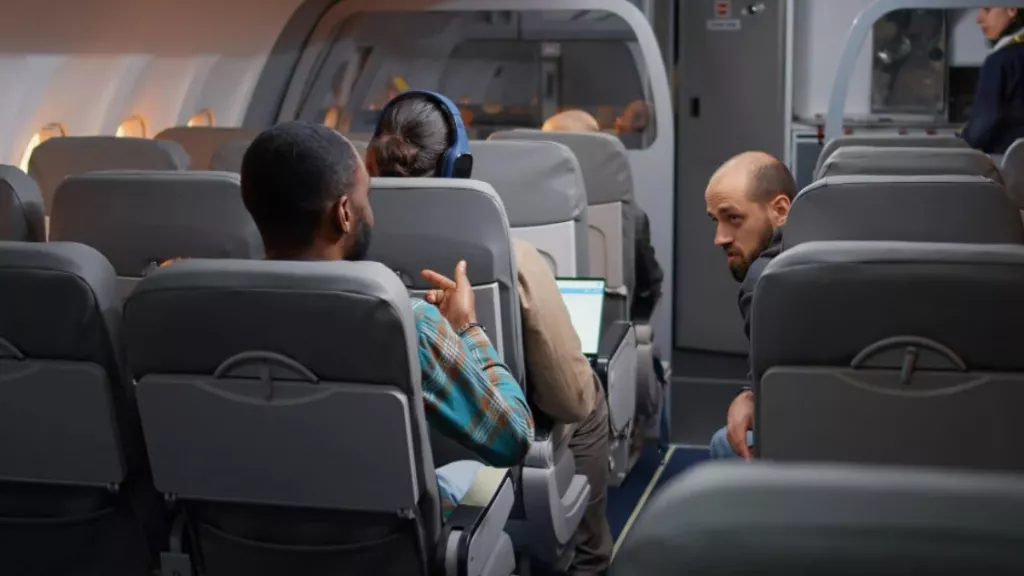
We started down the narrow aisle, with Lily walking ahead of me. She carried the diaper bag in front of her like a battering ram while I turned sideways to keep Noah from being bumped by other passengers.
Then I saw row 12.
My stomach sank.
A woman was already sitting there.
She had stretched herself across the window seat, 12A, which belonged to Lily. She appeared to be in her late forties, with blond highlights, large sunglasses pushed onto her head, and gold hoop earrings.
She wore expensive white headphones, and her eyes were closed.
Her camel-colored wool coat was spread across the middle seat, 12B, which was mine.
Her designer handbag sat on the tray table in front of it. One shiny black flat lay on the floor, and her bare foot rested against the cabin wall beneath the window.
She looked as though she had moved in.
“Mom,” Lily whispered, stopping in the aisle. “Isn’t that our row?”
“Yes,” I replied. “Let me handle it.”
I checked the numbers above the seats to make sure. Then I reached into the front pocket of Lily’s backpack and pulled out our boarding passes.
Row 12. Seat A. Row 12. Seat B.
Both were circled in blue pen. I had checked them twice.
My stomach tightened, but I told myself it was probably a simple mistake. People sometimes sit in the wrong seats. Perhaps she had confused row 12 with row 21. It should have been something we could resolve in thirty seconds with a smile and a boarding pass.
I pulled Noah a little closer and stepped forward.
“Excuse me,” I said pleasantly. “I’m sorry, but I think you might be in our seats.”
The woman didn’t open her eyes.
She didn’t move.
Behind me, passengers were gathering in the narrow aisle. A rolling suitcase bumped the back of my leg, and I heard another frustrated sigh.
Everyone nearby was beginning to watch.
I leaned closer.
“Excuse me,” I repeated more gently. “Those are our seats. My daughter has the window.”
The woman finally opened her eyes. She looked me up and down, taking in the baby carrier, the diaper bag, and Lily.
She didn’t remove her headphones.
“I heard you,” she said. “The first time.”
I held out our boarding passes.
“Ma’am, we paid extra for these two seats together. My daughter is ten. She needs to sit next to me.”
She let out a heavy sigh, as though I had interrupted something terribly important, and removed one earbud.
“Look, I’m already settled. I’ve got my things where I want them. My coat, my bag, my shoe off.” She gestured toward everything. “And honestly, mothers with babies always expect everyone else to rearrange their lives around them. You chose to travel with two children. That isn’t my problem.”
Heat rushed into my face.
Someone behind me muttered about the delay. Another passenger said, “Come on.”
I stood there with Noah against my chest and the boarding passes trembling in my hand. I couldn’t think of a single thing to say.
This was the moment, I thought, when a braver woman would stand up for herself, raise her voice, and make the stranger move.
But I just stood there.
Then Denise, the flight attendant, squeezed through the passengers behind me.
She looked at the boarding passes and checked something on her tablet. Her frown deepened as she tapped the screen.
Finally, she leaned toward me and spoke quietly.
“There’s been a double assignment,” she whispered. “The system issued seat 12A twice. It happens sometimes. I’m very sorry.”
“Okay. But she’s also occupying my seat, 12B. Her coat is on it.”
“I know,” Denise replied, pressing her lips together. “I’ve already asked her twice to move, before you boarded. She refused. I can’t remove her without a supervisor and a whole process, and we’ll lose our departure slot.”
She checked her watch.
“The flight is completely full. The only seat left is 15C, three rows behind this one, on the aisle.”
She looked at me apologetically.
“Your daughter can stay here in 12B, and you can take the baby to 15C. Or we can try to sort everything out after takeoff. But we need to close the doors now. We’re already four minutes late.”
I stared at her.
“You want me to leave my ten-year-old up here alone, next to this woman?”
Denise winced.
“I know, ma’am. I know it’s not okay. But as soon as the seatbelt sign goes off, I’ll come back and fix this myself. I’ll get you all moved together. And we’ll process a partial refund for the seat upgrade after landing. Please.”
From her comfortable position in 12A, the woman smirked. She had put her earbud back in, but she had clearly heard everything.
“Why should I move?” she said. “She’s the one traveling with all that.”
She flicked a perfectly manicured finger toward Noah, as though he were an oversized piece of luggage.
Noah whimpered against my collarbone. He was awake now, and I could feel my heart pounding.
His little blanket slipped out of the carrier again and landed near the woman’s bare foot.
I bent down awkwardly to pick it up. With Noah against my chest, I had to grip the armrest of 12B with my left hand to keep my balance while reaching down with my right.
As I straightened up, my left hand brushed the seat cushion and the woman’s coat.
Noah squirmed and opened his mouth to cry. I was focused entirely on him, tucking the blanket around his body and gently bouncing him.
I didn’t feel anything.
I didn’t notice a thing.
Then Lily tugged hard on my sleeve, twice.
“Mom,” she said. “Wait. I think something—”
She almost never interrupted adults. It was one of our rules. For a moment, I wondered what could possibly be so important.
But before she could finish, the woman snapped at her.
“Stop bothering me, kid.”
Lily hadn’t even been speaking to her. She had been trying to tell me something.
“God,” the woman added loudly, rolling her eyes toward the passengers in the next row. “Some children have no manners.”
Lily flinched. Her shoulders rose slightly, the way they did when she felt embarrassed.
She looked at the woman, then at me, and swallowed the rest of what she had been about to say.
“It’s okay, Mom,” she whispered. “I’ll be fine. I can see you from here.”
I crouched in the aisle, which wasn’t easy with Noah strapped against me. I brushed a loose strand of hair behind Lily’s ear.
“Are you sure, baby?”
She nodded.
“I’m sure.”
Every instinct in me screamed not to leave her there with that woman. But Noah was fussing, the aisle was blocked, and around thirty passengers were waiting behind us with their bags. Denise kept glancing at her watch.
Every second I stayed there made the situation worse.
And I wasn’t brave. I never had been.
So I gave in.
I hated myself for it, and a little part of me still does.
I kissed Lily’s forehead.
“Buckle up,” I told her. “If you need me for anything, press the call button. Anything at all.”
“I will.”
“Promise?”
“Promise, Mom.”
Lily squeezed past the woman’s knees and settled into 12B, the middle seat. She had to move the camel-colored coat to make room. She folded it carefully and placed it on the floor beside the woman’s feet.
The woman didn’t even thank her.
Lily put her purple owl backpack on her lap, fastened her seatbelt, and looked up at me.
I made my way three rows back to 15C.
The man in 15B was enormous. He was already asleep before takeoff, with his elbow spilling over onto my armrest. At least he didn’t seem bothered by the baby.
I took Noah out of the carrier, as the flight attendants required for takeoff, and held him on my lap with the infant belt attached to mine.
Then I immediately turned around to look toward row 12.
From 15C, I could see the back of Lily’s head if I leaned into the aisle.
I watched the woman beside her.
She stretched her long legs beyond her own space and pushed her bare foot into the area beneath Lily’s seat. Then, without removing her headphones, she planted her elbow firmly on the armrest between them.
She took the entire armrest.
Lily was squeezed against the opposite side of her seat, trying to make herself as small as possible.
I watched my daughter fold her hands quietly in her lap.
She didn’t complain, say a word, or press the call button. She simply sat there with her owl backpack on her knees.
I closed my eyes.
Just get through the flight, I told myself. Just breathe. Denise would come back.
The engines roared, and the plane rolled down the runway before lifting into the sky.
Noah startled awake and cried for about thirty seconds. I gave him a bottle to help with his ears, and he eventually settled down.
I kept my eyes on the back of Lily’s head.
Ten minutes later, a soft chime sounded, and the seatbelt sign switched off.
Noah drifted back to sleep against my chest.
At first, Lily was sitting perfectly still, with her hands folded and her eyes straight ahead.
Then I noticed her looking repeatedly to her left, toward the woman, and then down at the floor where the camel coat had been placed.
She looked back at the woman, then at the coat again.
Her expression began to change.
I knew what her frightened face looked like. This wasn’t it.
This was her thinking face. Her detective face. The expression she made when trying to remember where she had left a library book or figure out which neighbor’s dog had been digging up our tulips.
She seemed to be remembering something.
Then Lily unbuckled her seatbelt.
She stood in the space in front of her seat, still wearing her purple owl backpack.
I leaned into the aisle so I could see her better. Noah stirred against my chest.
Lily folded both hands neatly in front of her, as though she were about to give a school presentation.
She turned toward the woman in 12A.
“Ma’am,” she said.
Her voice was steady and clear, loud enough for me to hear three rows behind her.
“My mom taught me that you should never embarrass people in public. You should always try to tell them something quietly first. That’s why I tried to warn you quietly before, when we were sitting down.”
The woman groaned loudly and pulled out one earbud.
“Then stop talking, kid.”
Lily didn’t sit down.
She looked at the woman calmly for a long moment.
Then she asked:
“If that’s really your seat, why are you sitting on my mom’s wedding ring?”
The cabin fell completely silent.
The man in 12C across the aisle turned his head. A woman in 13A lowered her book. Conversations stopped in two nearby rows.
Even Denise, who was standing by the drink cart near the front, stopped pouring a ginger ale and turned around.
The woman in 12A gave a short, nasty laugh.
“I have absolutely no idea what you’re talking about.”
Lily pointed precisely at the gap between the seat cushion and the armrest.
“It fell off when my mom bent down to get Noah’s blanket before takeoff. She grabbed your armrest to balance herself, and her ring came off because it’s too big. It’s been too big for weeks.”
Lily took a breath.
“I was leaning around her to get my juice box from the seat. I saw the ring fall and roll right under your leg. That’s what I was trying to tell my mom before you yelled at me.”
I looked down at my left hand.
My stomach seemed to drop through the floor of the airplane.
The ring was gone.
My finger was bare, with only a faint pale band where it had rested for eleven years.
I suddenly remembered bending down for Noah’s blanket, gripping the armrest, and the woman shifting in her seat to rearrange her coat.
At the time, I hadn’t thought anything of it.
Now it was the most important moment of my entire morning.
Every passenger near row 12 leaned toward the woman’s seat.
I gripped Noah more tightly and felt my face grow hot. I hated myself for not being the one standing there, for leaving my daughter to defend us, and for losing the ring because I had been too busy and too tired to pay attention.
The woman rolled her eyes.
Then she lifted herself slightly off the seat, just enough to reveal the empty cushion.
“Well?” she announced. “Go ahead. Look.”
People actually searched.
The gray-haired man in 12C leaned across the aisle. The woman in 13A leaned forward over the seatback. Someone two rows ahead switched on a phone flashlight and pointed it toward the gap.
I held my breath.
Nothing.
There was no glint of gold. No ring. Only a crumpled napkin wedged into the gap and a single cracker crumb.
“See?” the woman said.
She settled back into her seat with a smug smile.
“Maybe you should teach your daughter not to make things up.”
I started to rise from my seat.
“Lily,” I called, my voice shaking. “Sit down, sweetheart. It’s okay. Come back here.”
But Lily didn’t move.
She remained standing, her hands still folded neatly in front of her.
Her eyes moved from the empty seat to the floor, where the camel-colored coat lay folded at the woman’s feet.
Then something seemed to click in her mind.
“You reached down,” Lily said quietly. “Right after it fell, when I was still bent over next to Mom, getting my juice box.”
The woman’s smile froze.
“I thought you were fixing your coat because it was on Mom’s seat,” Lily continued. “You picked it up a little, but you didn’t fix it. You put your hand down by your leg, where the ring was. Then you put your hand inside the pocket. Your coat pocket.”
She pointed toward the camel-colored coat.
“I saw it. I just didn’t understand what I was seeing until now.”
For a split second, panic flashed across the woman’s face. Then her smug expression returned, although it looked less convincing.
“Kids imagine all sorts of things,” she said loudly, spreading her hands as if asking the other passengers for sympathy. “Honestly. Some parents.”
A few people looked away, visibly uncomfortable.
My throat burned.
I imagined the ring disappearing forever inside that woman’s coat, leaving the plane with her and eventually ending up in a pawnshop for a couple hundred dollars.
Then I imagined having to tell Ethan, who was sitting beside his father’s hospital bed in Phoenix, that I had lost the one thing he had given me in the back booth of a diner eleven years earlier.
Every chapter. Always. E.
I began walking up the aisle.
I hadn’t consciously decided to. My legs simply started moving. I held Noah tightly against my chest and stepped into the aisle.
But Denise was already on her way.
She came quickly from the front of the plane, passing the drink cart and rows 10 and 11. Her mouth was pressed into a thin, serious line I hadn’t seen before.
She stopped at row 12, looked at Lily, then at the woman, and finally at the coat on the floor.
Without saying anything, she returned to the galley and picked up the interphone mounted on the wall.
She spoke quietly, listened for a few seconds, and gave a short nod.
Then she hung up and returned to row 12.
“Ma’am,” she said, looking directly at the woman. “I’ve just spoken with the captain.”
The color drained from the woman’s face.
“He has asked me to inform you that a passenger has reported the theft of personal property on this aircraft. Our policy requires us to ask you to voluntarily show us the contents of your coat pocket.”
Denise paused.
“If you refuse, the captain will radio ahead and request that airport police meet the aircraft at the gate after landing. You will be held on board while the report is investigated.”
She held the woman’s gaze.
“Your pocket, please, ma’am.”
The woman stared at her.
“Excuse me? Why would I do that? This is outrageous. Because some child—”
“Several passengers,” Denise interrupted evenly, “have reported seeing you bend down and pick something up before takeoff.”
The woman’s mouth opened, then closed.
Across the aisle, the gray-haired man in 12C cleared his throat.
He had been frowning thoughtfully throughout the exchange, as though trying to solve a difficult problem.
“I’ll be honest,” he said slowly. “I’ve been thinking about what happened while we were boarding. At first, I thought you were adjusting your bag. But the more I remembered it, the more certain I became.”
He looked directly at the woman.
“You slipped something into that coat. I saw you do it. I just didn’t know what it was.”
The woman in 13A leaned forward.
“I saw it too,” she said firmly. “You definitely put something in your pocket. You looked around first, as if you were checking whether anyone was watching.”
Every head in the front half of the plane turned toward row 12.
The woman began to stammer.
“This is ridiculous. I don’t have to—You can’t make me—”
Her hand hovered near the coat on the floor.
“Ma’am,” Denise repeated quietly. “Please.”
For a long moment, nobody moved.
I stood frozen in the aisle, holding Noah and barely breathing.
Then the woman slowly leaned down, picked up her camel-colored coat, and placed it on her lap.
She reached into the right-hand pocket.
When her fingers came out, they were holding my gold wedding ring.
A soft gasp traveled through the cabin.
The little diamond caught the light from the window. I could even recognize the dent on the side, the one from the kitchen counter.
I walked the final two rows toward them.
But I didn’t need to reach for it.
Lily got there first.
She held out her hand, calm and polite, with her palm facing upward.
The woman stared at her for a long moment.
Then she dropped the ring into Lily’s open hand.
Her own fingers were trembling.
Lily closed her hand around the ring, turned toward me, and placed it in my palm.
“It must have fallen in there,” the woman muttered, refusing to look at anyone. “Into my pocket when I moved my coat. I didn’t even notice.”
Nobody answered.
Nobody believed her. You could feel it throughout the surrounding rows.
Denise straightened.
“Please gather your belongings, ma’am. You’ll be sitting at the rear of the aircraft for the rest of the flight. Row 31, seat B. We’ll file an incident report after landing.”
“Row 31? That’s the middle seat. By the bathrooms.”
“Yes, ma’am,” Denise replied. “It is.”
The woman collected her coat and designer handbag, put her shiny black flat back on her bare foot, and squeezed into the aisle.
She walked past Lily, me, and Noah without looking at any of us. Then she made her way to the back of the aircraft while passengers turned to watch her go.
Someone in row 14 began clapping.
At first, it was only a young man wearing a college sweatshirt. Then the woman in 13A joined in, followed by the gray-haired man in 12C and several passengers behind them.
Soon, the entire front half of the plane was applauding.
They were applauding my daughter.
Lily turned bright red and lowered her head. She looked as though she wanted to disappear through the floor.
But she was smiling.
I finally sat down in 12B, the seat I had paid extra for.
Denise brought my diaper bag forward from 15C and knelt beside us in the aisle.
“I’m so sorry,” she said quietly. “For all of it. For asking you to move. I should have fought harder and gotten a supervisor. She shouldn’t have had to do that.”
“She did great,” I replied.
“She did amazing.” Denise gave Lily a small fist bump. “We’ll take care of the refund. And more. Leave it to me.”
Lily climbed into her window seat, 12A, at last.
She looked out at the clouds and then turned toward me.
I pulled her close, as much as I could with Noah resting against my other shoulder.
With trembling fingers, I slipped the ring back onto my finger and pushed it down until I felt its familiar weight.
Every chapter. Always.
I held my hand toward the window, and the tiny diamond caught the sunlight.
“Lily,” I said, my voice cracking. “How did you know? How did you even notice? I didn’t feel anything. I didn’t see anything. I’m the one wearing it.”
She shrugged as if it were nothing.
“I always watch your ring,” she explained. “Ever since it got too big. Every time you move your hand, I check because you said you’d fix it and you didn’t.”
She looked up at me.
“So I was being the ring manager. Just like the diaper bag manager.”
I laughed, although it was half laughter and half something else.
“And when she yelled at you, why didn’t you tell me right away? Why did you wait?”
“Because you told me,” Lily replied. “When I was seven, about the whales. You said you should tell people quietly first, just between them, so they have a chance to fix things.”
She frowned thoughtfully.
“I gave her a chance. When we sat down, I said, ‘Excuse me, I think you have something that belongs to my mom.’ I said it really quietly. But she put her headphones back in. So I tried to remember exactly what I saw, to make sure I was right. Then I said it louder.”
She shrugged again.
“I was just doing what you would do, Mom.”
I couldn’t bring myself to tell her that I wouldn’t have done the same.
I had stood in that aisle with my boarding passes shaking in my hand, unable to find my voice. I had surrendered my seat and left her alone because thirty strangers were sighing behind me and I was afraid of causing a scene.
The woman I had taught Lily to become was someone I had only pretended to be.
I simply kissed the top of her head and held her close, keeping Noah close too.
Somewhere above the clouds, I made two promises to myself.
First, I would never underestimate my daughter again.
Second, I would try to become the mother she already believed I was.
The rest of the flight was quiet.
Denise brought Lily an entire can of ginger ale instead of a small cup, three bags of pretzels, and a set of plastic pilot’s wings from a secret stash in the galley.
“Usually these are for the little kids,” she said, pinning them to Lily’s owl backpack. “But I think you’ve earned the real ones.”
About halfway through the flight, the gray-haired man in 12C leaned across the aisle.
“Young lady,” he said, “I was a police detective in Chicago for thirty-one years. I’m retired now, but that was some of the best witness work I’ve ever seen. You stayed calm, remembered the details, and didn’t accuse anyone until you were sure. That’s harder than it sounds.”
Lily stared at him with her mouth open.
“You were a real detective?”
“For thirty-one years.”
“I’m going to be a detective,” she said. “Or a marine biologist.”
He smiled.
“From what I’ve just seen, you’re already halfway to the first one.”
Lily didn’t stop smiling for the rest of the flight.
When we landed in Phoenix, two airport police officers were waiting at the gate.
They weren’t there for us.
They were there for the woman.
Denise asked us to remain in our seats while the other passengers disembarked. She told us the woman’s name was Carla and that this wasn’t the first incident report the airline had on file for her.
Six months earlier, another passenger had reported a missing watch on a different flight. Nobody had been able to prove anything at the time.
“Your daughter might have just helped close two cases,” Denise told me.
An officer took my statement in the jet bridge, followed by Lily’s. She explained everything slowly and clearly, with her hands folded in front of her.
The officer wrote it all down.
When she finished, he looked at me.
“Is she always this observant?”
“Always,” I replied.
“Hang on to her.”
“I plan to.”
Ethan was waiting at the bottom of the escalator in baggage claim.
He looked exhausted after four days of hospital chairs and vending-machine coffee. He hadn’t shaved, and his shirt was wrinkled.
But the moment he saw us coming down the escalator, his face lit up.
Lily ran the final few steps and threw herself into his arms. He caught her and spun her around, even though she was getting far too big for that.
Then he wrapped his arms carefully around me and Noah.
“How’s your dad?” I asked against his shoulder.
“Better,” he said. “He’s sitting up, asking for real food, and asking about his grandson every five minutes.”
He pulled back to look at Noah, who was asleep in the carrier.
“How was the flight?” he asked. “Was it awful, traveling alone with both of them?”
Lily and I exchanged a look.
“Dad,” she said. “You’re not going to believe this.”
She told him the entire story as we walked through the parking garage and toward the car. She acted out every voice, from the impatient businessman to the woman complaining about children, and even Denise asking to see the coat pocket.
When Lily reached the moment the ring came out, Ethan stopped walking.
He looked at my hand, then at the ring, and finally at our daughter.
For a long moment, he said nothing.
Then he knelt in front of her on the concrete, right there in the parking garage with cars passing nearby.
“You know I saved up for that ring for seven months?” he asked. “In a coffee can?”
“Mom told me,” Lily replied. “Lots of times.”
“It’s the most important thing I ever bought,” Ethan said, his voice rough. “And you saved it.”
“I was the ring manager,” Lily answered simply.
Ethan laughed, but his eyes filled with tears. He pulled her into a hug and held her for a long time.
The following morning, before we went to the hospital, Ethan drove us to a small jeweler near the hotel.
It wasn’t a fancy store. It was a tiny family business squeezed between a dry cleaner and a taco shop. An elderly man stood behind the counter, with a magnifying loupe resting on his forehead.
“I need this resized,” I told him, placing the ring on the glass counter. “It’s been too big for weeks. It fell off yesterday, on an airplane. I almost lost it forever.”
The jeweler picked it up, turned it between his fingers, and held it toward the light.
Then he read the engraving inside.
Every chapter. Always. E.
He looked up at me over his loupe.
“Somebody saved up for this.”
“In a coffee can,” Lily added.
The old man smiled slowly.
“Those are the best ones. The coffee-can rings.”
He placed it carefully on a small velvet pad.
“Come back in an hour. I’ll make sure it never goes anywhere again.”
An hour later, the ring fitted perfectly.
It was snug and secure, just as it had been before.
I slipped it on in the shop and held my hand toward the window. The tiny diamond caught the Arizona sunlight.
Lily leaned over to inspect it. She turned my hand back and forth, then tugged gently on the ring with two fingers to make sure it wouldn’t come off.
“Okay,” she said at last. “I approve.”
“Thank you, ring manager.”
“You’re welcome.” She looked up at me. “Does this mean I’m fired?”
“No, baby,” I said, pulling her close. “It means you’re promoted.”
That afternoon, in a hospital room in Phoenix that smelled of hand sanitizer and lime Jell-O, Ethan’s father held his grandson for the first time.
He cried quietly, tears running down toward the oxygen tube beneath his nose.
“Look at him,” he whispered. “Look at this little guy. Bald as an egg.”
Lily stood beside the bed, with her plastic pilot’s wings still attached to her owl backpack.
“Grandpa,” she said, “do you want to hear about the airplane?”
He looked at her.
“Was something wrong with the airplane?”
“No,” Lily replied. “Something was wrong with a lady.”
Then she told the entire story again, complete with all the voices.
Ethan’s father laughed so hard that a nurse came in to make sure his stitches were all right.
I’ve thought about that flight many times since then.
I’ve thought about standing in the aisle with my boarding passes trembling in my hand, unable to find my voice. I’ve thought about giving up my seat because I was more afraid of thirty strangers sighing at me than I was of leaving my daughter alone.
For eleven years, I had spent too much time apologizing for taking up space. I accepted the wrong meals, let people cut in front of me, and avoided making a fuss.
And then a ten-year-old girl with brown braids and an owl backpack stood up in the middle of an airplane, folded her hands as if she were giving a school presentation, and politely refused to let someone walk away with something that wasn’t hers.
She didn’t shout or create a scene.
She did exactly what I had taught her. She tried quietly first, gathered the facts, and waited until she was certain.
Then she said it louder.
I had taught her that.
I just hadn’t learned to do it myself.
I’m learning now.
Last week, at the grocery store, a cashier accidentally scanned my avocados twice. A year ago, I would have paid the extra two dollars and fifty cents without saying anything. It wouldn’t have seemed worth the trouble.
This time, I simply said, “Excuse me. I think those were scanned twice.”
The cashier checked, apologized, and corrected the mistake.
That was all. Thirty seconds. No argument. No scene. Nobody died.
Lily was standing beside me, holding the shopping cart.
She didn’t say a word.
But she looked up, smiled, and gave me a very small, very serious thumbs-up.
I still have a long way to go.
But at least now I know who I can learn from.